



The 50 Percent Rule: When to Stop Repairing Your 15-Year-Old Furnace
Facing a Major Repair Before the Winter Freeze
As the September pre-heating season rapidly approaches here in Loveland, our team at Compass Heating & Cooling often meets homeowners who discover a major breakdown during a routine fall tune-up. This situation leads them straight to The 50 Percent Rule: When to Stop Repairing Your 15-Year-Old Furnace. You scheduled an early inspection to ensure your home would stay warm, only to receive a diagnosis that requires a significant, unexpected investment. This is a stressful position for any homeowner, but it is also a critical decision point that requires objective thinking rather than panic.
Before the first hard freeze arrives, you need a reliable, emotion-free framework to decide whether to invest in fixing the aging unit or move forward with an upgrade. To make the most financially sound choice, you can reach out for professional HVAC services to accurately diagnose the system before committing to a complete heating system replacement.
Understanding the 50 Percent Rule for HVAC Systems
When you are staring down a costly repair bill for an aging heating system, it is easy to fall into the trap of the sunk cost fallacy. You might think that because you have already maintained the unit for over a decade, you should just pay for one more fix to keep it running. This is where the 50 percent rule provides much-needed clarity.
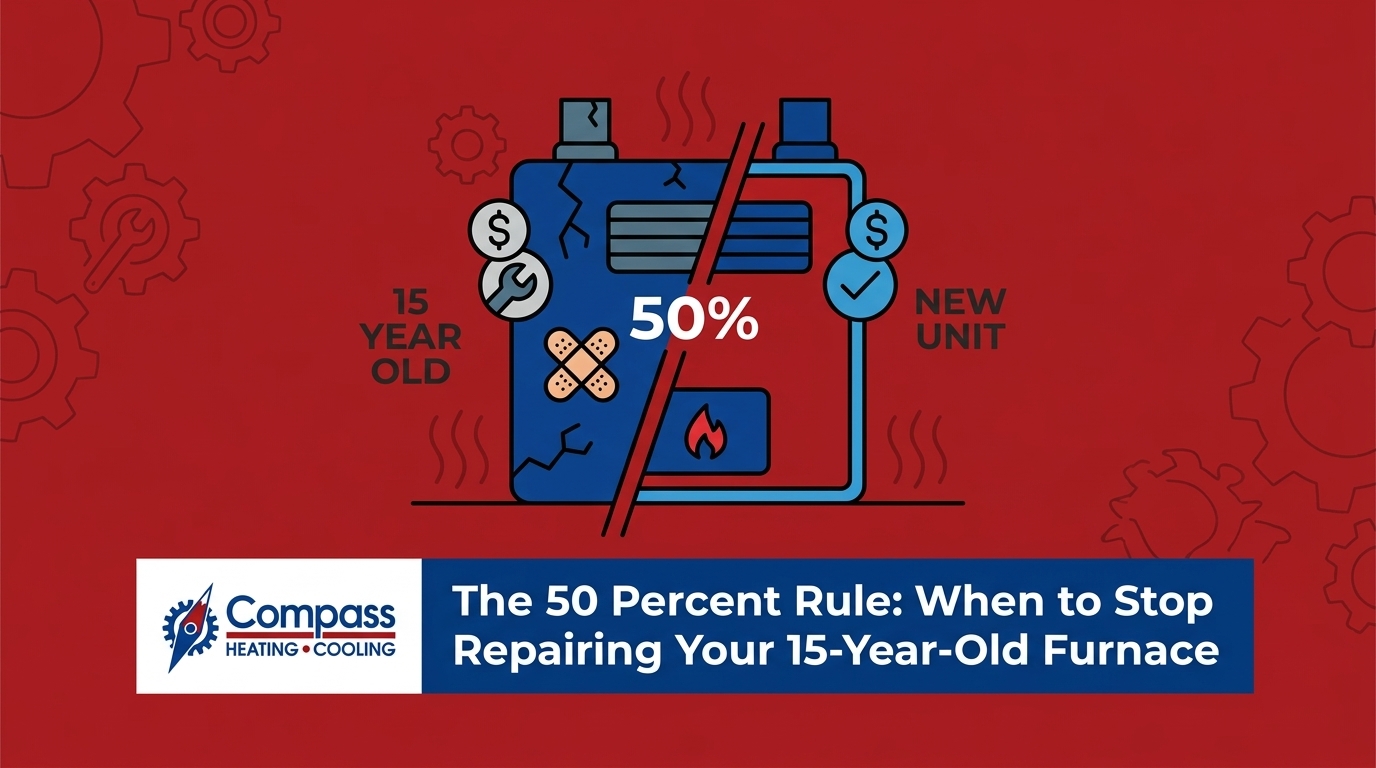
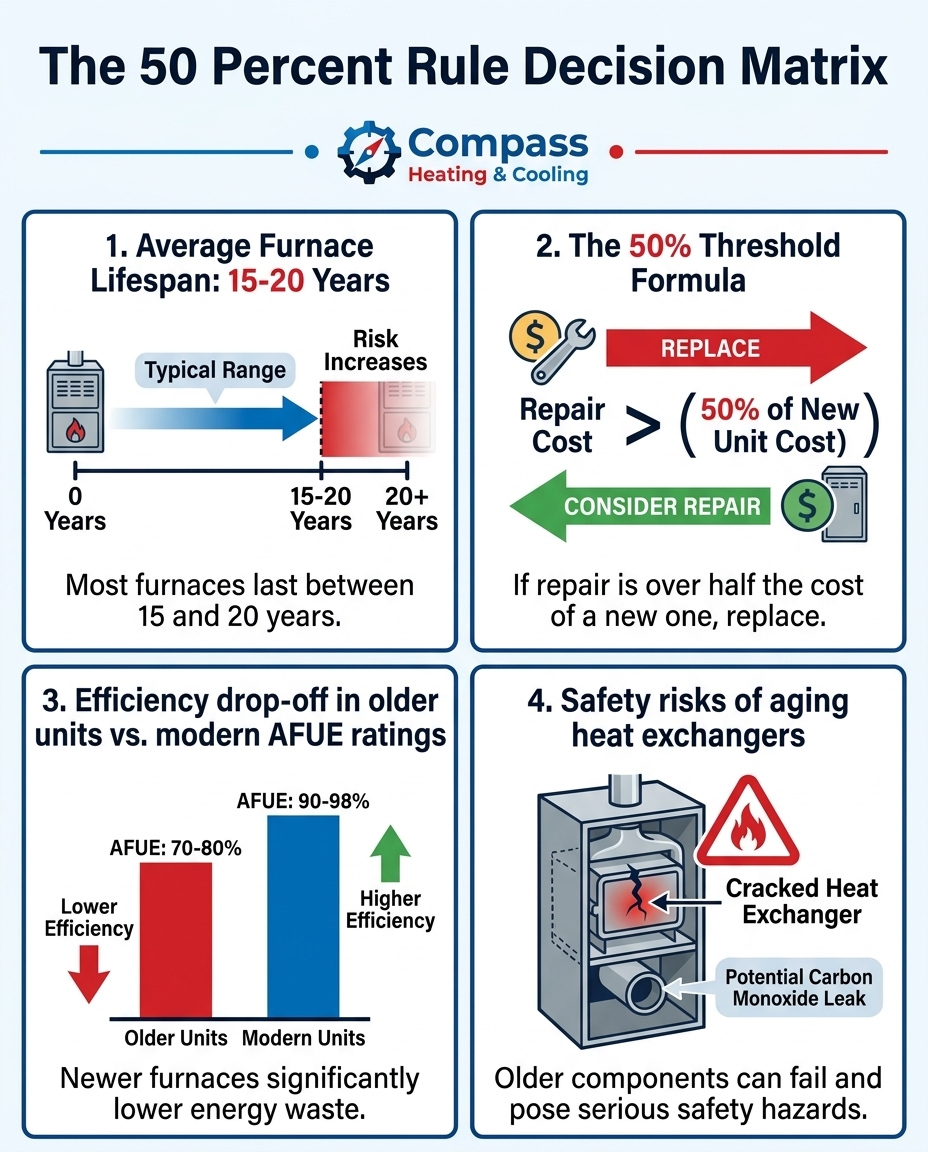
The core formula: The 50 percent rule states that if the cost of repairing your aging furnace is more than half the cost of a new replacement system, it is generally more cost-effective to replace it. This rule acts as an objective financial boundary, removing the emotion and frustration from your decision-making process.
Calculating Proportional Value
Because every home requires a different size and type of heating system, it is vital to calculate this using proportional logic rather than getting fixated on the immediate repair bill alone. If you receive a quote for a major component failure—like a cracked heat exchanger or a seized blower motor—you must weigh that single repair against the total investment of a modern, highly efficient unit.
If that repair eats up more than half the budget you would otherwise spend on a brand-new, fully warrantied system, investing in the old unit is a poor long-term strategy.
The Danger of Compounding Repairs
In our years of diagnosing heating systems across the area, we consistently see that a 15-year-old furnace rarely stops at just one major failure. As internal components reach the end of their engineered lifespans, they begin to fail in a cascading sequence. You might replace the draft inducer motor in October, only to have the primary control board fail in December. By applying the 50 percent rule, you protect yourself from pouring funds into a failing unit that will inevitably need replacing in the near future anyway.
Factoring in Age: The Reality of a 15-Year-Old Furnace
Age is one of the most critical variables in the repair versus replacement equation. Our technicians typically see the average lifespan of a well-maintained residential gas furnace top out around 15 to 20 years. Once your equipment enters this final stage of its lifecycle, the wear and tear on critical components becomes undeniable.
Even if you have been diligent about swapping out air filters and scheduling seasonal tune-ups, the constant expansion and contraction of metal parts takes a toll. The heat exchanger, which safely separates the combustion exhaust from the breathable air circulating through your home, undergoes immense thermal stress over a decade and a half. Applying a major, expensive fix to a unit in this age bracket often just delays the inevitable replacement by a very short margin.
To help visualize the difference in outcomes, here is a side-by-side look at what you can expect when choosing between patching an old system and investing in a new one:
• Reliability — Patching a 15-Year-Old Furnace: Low. One fixed part does not prevent other aging components from failing mid-season. — Installing a New Heating System: High. Brand-new components engineered to work together seamlessly for years.
• Energy Efficiency — Patching a 15-Year-Old Furnace: Declining. The unit will continue to use more fuel to produce less heat over time. — Installing a New Heating System: Maximized. Modern AFUE ratings ensure minimal fuel waste and lower utility bills.
• Warranty Coverage — Patching a 15-Year-Old Furnace: Expired. You will pay entirely out of pocket for any future repairs and labor. — Installing a New Heating System: Comprehensive. New systems come with robust manufacturer warranties on major parts.
• Safety Risks — Patching a 15-Year-Old Furnace: Increasing. Older heat exchangers carry a higher risk of cracking and leaking exhaust. — Installing a New Heating System: Eliminated. Factory-fresh safety controls and intact heat exchangers protect your home.
The Hidden Costs of Inefficiency
When you are weighing the 50 percent rule, the upfront repair quote is only part of the financial picture. You must also account for the operational costs of running an aging, inefficient unit against the monthly savings provided by modern high-efficiency replacements.
Understanding AFUE Ratings
Furnace efficiency is measured by Annual Fuel Utilization Efficiency (AFUE). This rating tells you what percentage of the fuel consumed is actually converted into usable heat for your home. A 15-year-old furnace may have been rated at 80% AFUE when it was brand new. This means that even at its peak, twenty percent of the energy you paid for was lost as exhaust gas.
However, as systems age and parts wear down, they rarely maintain their original efficiency rating. An older, struggling system uses significantly more energy to produce the exact same amount of heat. If your older unit has dropped to an effective 70% efficiency, thirty percent of your heating budget is essentially vanishing into thin air every time the thermostat calls for heat.
Offsetting the Cost of Upgrades
In contrast, modern heating systems routinely achieve AFUE ratings of 95% or higher. Upgrading means nearly all the fuel you pay for is converted directly into indoor comfort. Furthermore, generic federal tax credits and local utility rebates may be available for qualifying high-efficiency upgrades. These incentives can help offset the initial replacement costs, making the transition to a new unit much more manageable.
When you factor in the monthly energy savings from a new, high-efficiency unit alongside potential tax incentives, the long-term math heavily favors replacement. This hidden cost of inefficiency is exactly why the 50 percent rule is such a valuable guideline for homeowners.
Climate Considerations: When Reliability Becomes a Safety Issue
Your geographic location plays a massive role in how strictly you should apply the 50 percent rule. Having served the local community for years, our team knows firsthand that the weather here does not offer much forgiveness during the colder months. Loveland CO experiences average winter temperatures that drop well below freezing, meaning that a functional heating system is not just about comfort—it is a critical necessity.
The Danger of Mid-Winter Breakdowns
Pushing an old system past its limits risks a sudden, catastrophic breakdown during the absolute coldest weeks of the year. If you authorize a major repair during a September pre-heating season inspection, you are gambling that the rest of the 15-year-old components will survive the heavy workload of January and February. If they fail, your home can lose heat rapidly, leading to frozen pipes, severe property damage, and unsafe living conditions for your family.
Prioritizing Family Safety
Beyond the risk of losing heat, there are severe safety concerns associated with a failing heat exchanger in an aging unit. The heat exchanger is the metal shield that contains the combustion gases—including carbon monoxide. After 15 years of expanding from heat and contracting from cold, the metal becomes fatigued. A crack in this component can allow dangerous, odorless carbon monoxide to leak into your home's airflow.
When you view the situation through this lens, a proactive replacement is an investment in family safety and uninterrupted comfort. Relying on trusted Loveland heating services ensures that your home is equipped with a modern, reliable system that can handle the harshest winter nights without putting your household at risk.
Why You Should Always Verify a Major Repair Diagnosis
Receiving a major repair quote on an older unit can be overwhelming, but it is vital to remember that you hold the decision-making power. Major repair diagnoses on aging units should never be taken at face value without verification, especially when the required investment approaches the 50 percent threshold.
The Value of an Alternative Perspective
Heating systems are complex networks of electrical, mechanical, and combustion components. Occasionally, a symptom that looks like a catastrophic failure might actually be caused by a much smaller, less expensive issue. For example, a furnace that repeatedly shuts down might be diagnosed as having a failing primary control board, when the actual culprit is a dirty flame sensor or a restricted exhaust flue.
This is why seeking an alternative perspective is so important. We've rescued countless Loveland homeowners from unnecessary premature replacements simply by catching a minor, easily fixable issue like a dirty sensor during a second opinion. An honest, secondary evaluation can confirm if the 50 percent threshold has truly been crossed, or if a simpler solution is available. At Compass Heating & Cooling, our team is highly committed to providing honest, second-opinion assessments without any high-pressure sales tactics. We believe homeowners deserve a transparent, pressure-free evaluation so they can make the best choice for their specific situation.
If you are unsure about a recent quote you received, taking the time to verify the diagnosis can provide immense relief. You can learn more about the benefits of this process by reading our guide on getting a second opinion on HVAC repairs.
Next Steps if You Choose to Repair
Sometimes, after applying the 50 percent rule and verifying the diagnosis, you may find that the repair quote falls well below the threshold. If your 15-year-old furnace has been meticulously maintained and the required fix is relatively minor, choosing to repair the unit can still make sense for another season or two. However, keeping an aging system running requires vigilance.
If you decide to keep your current unit, our team strongly recommends following these proactive steps to protect your home:
1. Commit to routine professional care: The absolute necessity of ongoing, proactive care cannot be overstated for aging systems. Schedule routine furnace maintenance to ensure a technician can monitor the system's health throughout the winter.
2. Monitor your energy bills closely: Keep a close eye on your monthly utility statements. A sudden, unexplained spike in energy consumption is often the first early warning sign that the system is losing efficiency and struggling to keep up with demand.
3. Listen for unusual operational noises: Pay attention to how the unit sounds when it cycles on and off. Grinding, squealing, or loud banging noises are indicators that internal components are wearing out and may soon fail.
4. Start planning for the inevitable upgrade: Even with a successful repair, a 15-year-old furnace is living on borrowed time. Use this extended window to research modern systems, explore generic tax credits, and budget for a replacement on your own timeline rather than during an emergency breakdown.
Frequently Asked Questions About Aging Furnaces
What is the 50 percent rule for HVAC?
The 50 percent rule is a financial guideline stating that if repair costs exceed half the cost of a new replacement system, replacing the unit is the wiser choice. It helps homeowners make an objective decision by weighing the immediate repair bill against the long-term value of a brand-new, highly efficient, and fully warrantied system.
Is it worth repairing a 15-year-old furnace?
It depends entirely on the repair severity, but given the 15-to-20-year average lifespan of these units, major repairs are usually not recommended. If the fix is minor and inexpensive, a repair might buy you another season; however, if the repair involves a major component like the heat exchanger or blower motor, the 50 percent rule usually dictates that replacement is the smarter investment.
How long should a gas furnace last?
With proper, consistent professional maintenance, most residential gas furnaces last between 15 and 20 years before their efficiency and reliability sharply decline. Once a system enters this age bracket, the internal components suffer from significant thermal fatigue, increasing the likelihood of cascading mechanical failures.
When should you just replace a furnace?
You should replace your heating system when necessary repairs cross the 50 percent threshold, when critical safety components like the heat exchanger show signs of cracking, or when your energy bills spike drastically due to lost efficiency. Additionally, if your system requires frequent, consecutive repairs just to make it through a single winter, it is time for an upgrade.
Can a second opinion change a furnace diagnosis?
Yes, an honest second evaluation can sometimes reveal that a seemingly catastrophic issue is actually a simpler, more manageable fix. Because modern heating systems are complex, a symptom that looks like a major failure might stem from a minor electrical fault or sensor issue, making a no-pressure second opinion highly valuable.
Make Your Heating Decision With Confidence
Navigating a major repair quote on an aging system does not have to be an overwhelming experience. By applying the 50 percent rule, you gain a clear, objective path forward that prioritizes your financial well-being and your home's long-term comfort. Remember that acting quickly during the early fall tune-up season is vital before the deep winter freeze sets in and limits your options.
If you are facing a difficult choice regarding your 15-year-old furnace, you do not have to make the decision alone. We encourage you to reach out for a professional, no-pressure evaluation to thoroughly explore your options and ensure your home stays reliably warm all winter long.
hear what our satisfied clients have to say
Our clients consistently praise our exceptional service and attention to detail. They appreciate the personalized approach we take to meet their unique needs, ensuring satisfaction every step of the way.
.png)