



What That Burning Smell Means When You Turn On Your Furnace in September
The Sudden Panic of the First Fall Furnace Cycle
September is finally here, and knowing exactly what that burning smell means when you turn on your furnace in September can be the difference between a cozy evening and a panicked call to the fire department. The crisp early fall mornings in Northern Colorado eventually force every homeowner to walk over to the thermostat and switch the system from cool to heat. Within minutes of that first cycle, a strange, distinct burning odor often spreads through your vents and fills the living room. Your immediate reaction is completely understandable alarm—is the heating system catching fire?
Here at Compass Heating & Cooling, our team sees this exact scenario play out every September. In our years of servicing Loveland and Front Range homes, we've taken countless panicked phone calls during that early fall first furnace run of the year. In that moment, you have to make a quick decision: is this just a harmless seasonal quirk, or a genuine safety hazard that requires immediate action? Understanding these common early-season smells prevents unnecessary panic while keeping your home perfectly safe. By knowing what to sniff for, you can confidently tell the difference between normal operation and a true mechanical emergency.
If you need professional help assessing your system, our comprehensive HVAC services are designed to keep your home safe and comfortable all year round.
Why Your Dormant Furnace Collects So Much Debris
To understand the smell, you have to look at what your heating system has been doing for the last six months: absolutely nothing. Furnaces sit completely idle throughout the long summer cooling season. Because Loveland CO and Front Range homes experience a hot, dry summer climate, our technicians typically see a significant amount of fine, dry dust circulate through a home's ductwork while the air conditioner runs.
The Hidden Accumulation Problem
Even with a good air filter in place, microscopic airborne particulates, pet dander, dead skin cells, and fine dirt manage to slip through the system. Over the summer months, this debris settles directly onto the cold, dormant metal surface of your furnace's heat exchanger. The heat exchanger is the core component that eventually warms the air blowing into your rooms, but during the summer, it acts like a giant dust magnet sitting in a dark cabinet.
The Incineration Process
The first time your thermostat calls for heat, the furnace burners ignite. Within seconds, the metal heat exchanger rapidly warms up to several hundred degrees. That accumulated layer of fine dust and pet dander doesn't just blow away—it is instantly incinerated by the intense heat. This flash-burning of settled debris creates a very specific, toasted odor inside the cabinet.
The Distribution Phase
Immediately after the heat exchanger warms up, your system's powerful blower fan kicks on. This fan pushes air over the hot metal, picking up the incinerated dust particles and the accompanying smell, and forcefully distributes it throughout your home's ductwork. Within moments, every supply vent in your house is pushing that distinct burning odor into your living spaces. While it is certainly alarming the first time it happens, this is a standard mechanical process. However, if you are ever concerned about the intensity of the odor, scheduling a professional heating repair and inspection is the best way to verify your system is operating safely.
Sensory Guide: Recognizing Harmless Dust Burn-Off
Because you cannot safely open the furnace cabinet to see what is happening while the system is running, you have to rely on your senses. Harmless dust burn-off has a very specific sensory profile. Knowing exactly what is normal can save you a lot of stress during that September early fall first furnace run.
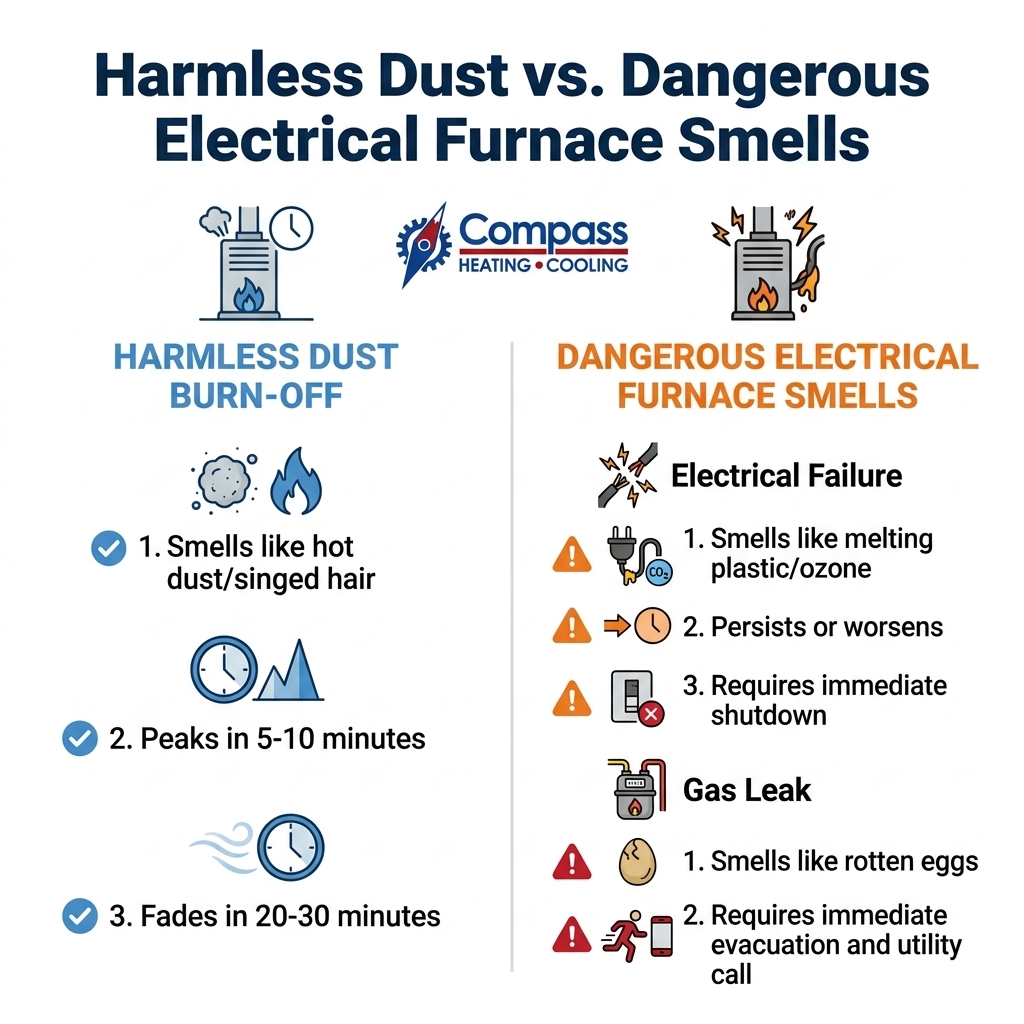
• The exact scent: Normal dust burn-off smells like a hot, dusty radiator, slightly singed hair, or the warm exhaust air blowing out of the back of a vacuum cleaner. It is a dry, earthy, and mildly toasted smell. It should never smell sharp, chemical, or metallic.
• The timeline: The odor should peak within the first 5 to 10 minutes of operation. This is when the heat exchanger reaches its maximum temperature and burns off the bulk of the settled summer debris.
• The dissipation period: The smell should completely fade away within 20 to 30 minutes. As the dust is cleared and the system cycles fresh air through the home, the odor will naturally thin out and disappear.
• Ventilation tips: We highly recommend opening a few windows to help ventilate the home during this brief period. Cracking a window creates cross-ventilation, which clears the indoor air much faster and keeps your home smelling fresh.
How Long Is Too Long for Dust Odors?
While a brief dusty smell is perfectly normal, a lingering one is not. If the dusty smell persists for hours, or if it returns every single time the furnace kicks on over subsequent days, it indicates a severe airflow blockage. The most common culprit is a heavily clogged air filter. When the filter is packed with dirt, the blower motor cannot pull enough cool air over the heat exchanger. This causes the metal to run much hotter than it is designed to, leading to continuous overheating and a lingering, hot-metal smell that will eventually trigger the system's safety shutdown switches.
Red Alert: Identifying Dangerous Electrical and Plastic Smells
Not all early-season odors are harmless. It is vital to contrast the normal smell of burning dust with the dangerous sensory indicators of electrical failure. In our experience responding to emergency heating calls across the Front Range, an electrical smell is never a normal part of the seasonal transition. At Compass Heating & Cooling, our technicians have seen firsthand the damage caused by ignoring these warning signs, which is why our commitment to safety means we always emphasize that a professional inspection is the only safe way to resolve electrical odors.
The scent of electrical failure is distinctly different from burning dust. It is acrid, sharp, and highly unpleasant. You might smell melting plastic, burning rubber, or a metallic ozone scent (similar to the smell of a sparking power tool). These odors typically point to serious internal issues, such as failing blower motors, overheating starting capacitors, or wire insulation melting due to a short circuit. Unlike dust burn-off, these smells will not fade after 30 minutes; in fact, they often grow much more intense the longer the system runs.
Strict Safety Warning: Never open the furnace cabinet or attempt any DIY electrical diagnostics if you smell melting plastic or ozone. Modern heating systems carry high voltage and pose severe fire and shock risks. Rely on a licensed professional to handle internal electrical components.
• Hot dust, singed hair, vacuum exhaust — Typical Root Cause: Summer dust burning off the heat exchanger — Expected Timeline: Fades within 20-30 minutes — Required Action: Open windows, let it pass
• Acrid, melting plastic, burning rubber — Typical Root Cause: Melting wire insulation, overheating motor — Expected Timeline: Persists or grows stronger — Required Action: Shut down immediately, call a pro
• Metallic ozone, electrical sparking — Typical Root Cause: Failing capacitor, short circuit — Expected Timeline: Constant while running — Required Action: Shut down immediately, call a pro
• Rotten eggs, sulfur — Typical Root Cause: Natural gas leak (mercaptan additive) — Expected Timeline: Immediate and overwhelming — Required Action: Evacuate home, call utility company
Exactly When to Hit the Emergency Shutoff Switch
When you are dealing with potential electrical or fire hazards, hesitation can lead to severe property damage. You need actionable, definitive guidelines on when to stop diagnosing the smell and simply turn off the system. During your September early fall first furnace run, if things do not seem right, follow these exact steps to secure your home.
1. Identify the electrical hazard: If you smell melting plastic, burning rubber, or a sharp ozone scent, immediately flip the furnace shutoff switch. This switch usually looks like a standard light switch mounted on the wall next to the unit or at the top of the basement stairs. If you cannot find it, turn off the system at the main breaker panel.
2. Monitor the time limit: Shut down the system if a dusty smell persists beyond the initial 30-minute window. While dust is normal, a smell that lasts for hours indicates the system is dangerously overheating, likely due to a blocked filter or a failing blower motor that cannot move air properly.
3. React to gas odors instantly: Instruct your entire family on this rule: if there is any smell of rotten eggs (which is the mercaptan additive put into natural gas), execute an immediate shutdown and evacuation. Do not turn on lights, do not use your cell phone inside, and leave the doors open as you exit. Call your utility provider from outside the home.
4. Prevent catastrophic damage: Shutting the system down early is the best way to protect your investment. Stopping a failing motor before it seizes completely prevents catastrophic component damage and minimizes the risk of a serious electrical fire inside your ductwork.
Proactive Steps to Eliminate Early-Season Odors
While a little bit of dust burn-off is inevitable, severe odors and the anxiety they cause can be entirely prevented with proper late-summer preparation. Transitioning from immediate troubleshooting to long-term prevention is the best way to protect your Loveland CO and Front Range homes. A pattern we see often is that homeowners who skip their late-summer maintenance end up dealing with the strongest odors. Proactive care is our core philosophy for avoiding mid-winter breakdowns and unexpected safety hazards.
The most important step you can take as a homeowner is to change your air filter before turning the system on for the first time in September. A fresh filter ensures maximum airflow, which keeps the heat exchanger operating at a safe, controlled temperature. If your filter is already packed with summer dust, your system is going to struggle from the very first cycle.
Beyond the filter, professional intervention makes a massive difference. When a professional technician performs late-summer maintenance, they physically clean the heat exchanger, removing the bulk of the settled dust before it ever has a chance to burn. They also inspect all electrical components, tighten loose wire connections, and test the blower motor to ensure nothing is at risk of melting or shorting out. Scheduling routine furnace maintenance is the most effective pre-season care you can invest in, guaranteeing both safety and efficiency throughout the freezing winter months.
The Value of a Comprehensive Fall Inspection
A comprehensive fall inspection goes far beyond just wiping down the cabinet. A certified technician performs specific, highly technical checks that a homeowner simply cannot safely do. This includes testing the high-limit safety switches, measuring the electrical amp draw on the motors, and using specialized cameras to inspect the heat exchanger for microscopic, dangerous cracks that could leak carbon monoxide. To understand the full scope of these critical safety checks, you can read more about why you need a furnace tune-up before the freezing weather arrives.
Enjoy a Safe, Odor-Free Heating Season
Understanding the difference between the normal, brief smell of burning dust and the dangerous, lingering odors of electrical failure is key to your peace of mind. As you prepare your Loveland CO and Front Range homes for the colder months, always trust your senses and prioritize safety above all else. Knowing exactly what that burning smell means when you turn on your furnace in September empowers you to act decisively. If you have any lingering doubts about your system's odors or performance, don't hesitate to schedule an inspection with our expert Loveland heating technicians to ensure a safe, warm, and worry-free winter.
Frequently Asked Questions
Is it normal for a furnace to smell like it's burning when you first turn it on?
Yes, a brief burning smell is completely normal during the first few cycles of the season. This odor is caused by the sudden incineration of dust, pet dander, and airborne debris that has settled on the dormant heat exchanger over the summer. As long as the smell resembles hot dust and fades quickly, it is a standard part of the seasonal transition.
How long does furnace dust burn-off last?
The smell of dust burning off should peak within the first 5 to 10 minutes of operation and completely dissipate within 20 to 30 minutes. Once the initial layer of debris is cleared from the heat exchanger, the odor will fade as fresh air circulates through your ductwork. If the smell lasts for several hours, you should shut the system down and check your air filter.
Should I turn off my furnace if it smells like burning?
You should turn off your furnace immediately if the burning smell resembles melting plastic, burning rubber, or a metallic ozone scent. These odors indicate a dangerous electrical failure or overheating component. However, if the smell is just the dry, earthy scent of hot dust during the first run of the season, it is safe to let it run for 30 minutes to clear the system.
Why does my heater smell like burning plastic?
A burning plastic smell typically indicates that wire insulation is melting or an electrical component, such as a capacitor or circuit board, is failing. This is a severe fire hazard that will not resolve itself. You must immediately turn off the system at the shutoff switch or breaker and call a licensed professional for an inspection.
What does an electrical fire in a furnace smell like?
An electrical fire in a heating system produces a sharp, acrid, and highly unpleasant odor. It often smells like melting plastic, scorching rubber, or a metallic, sparking ozone scent similar to a hot power tool. Unlike harmless dust, this smell is intense, chemical in nature, and grows stronger the longer the system operates.
Can a dirty air filter cause a burning smell?
Yes, a severely clogged air filter can cause a lingering burning smell by drastically restricting airflow. Without enough cool air moving over the heat exchanger, the metal components overheat, creating a hot-metal or dusty burning odor that persists long after the initial startup. Replacing the filter regularly is the best way to prevent this dangerous overheating cycle.
hear what our satisfied clients have to say
Our clients consistently praise our exceptional service and attention to detail. They appreciate the personalized approach we take to meet their unique needs, ensuring satisfaction every step of the way.
.png)