



Breaking Down the True Cost of Furnace Replacement in Fort Collins
What Really Drives the Scope of a Heating Upgrade?
When you start Breaking Down the True Cost of Furnace Replacement in Fort Collins, what actually determines the scale of your new heating installation? Is it just the brand name on the box, or is there something more mechanical going on behind the scenes? For many homeowners, the variables surrounding a new heating system can feel confusing and overwhelming. You might assume that replacing a unit is a simple one-for-one swap, but the reality is much more complex.
The true investment required for a new heating system is dictated by your home's specific mechanical requirements, not just an arbitrary budget tier. Every house has a unique footprint, existing ductwork conditions, and architectural quirks that dictate how a new unit must be installed. If you are exploring different HVAC services, understanding these mechanical variables is the key to making an informed, confident decision.
Here in Fort Collins and the Colorado Front Range, our specific climate demands make this understanding crucial before freezing temperatures arrive. A system that works perfectly for a mild coastal climate will struggle against our rapid temperature drops and high altitude. By evaluating the structural and mechanical scope of the project upfront, you can ensure your home stays consistently warm without unexpected installation surprises down the road.
How AFUE Ratings Change the Installation Process
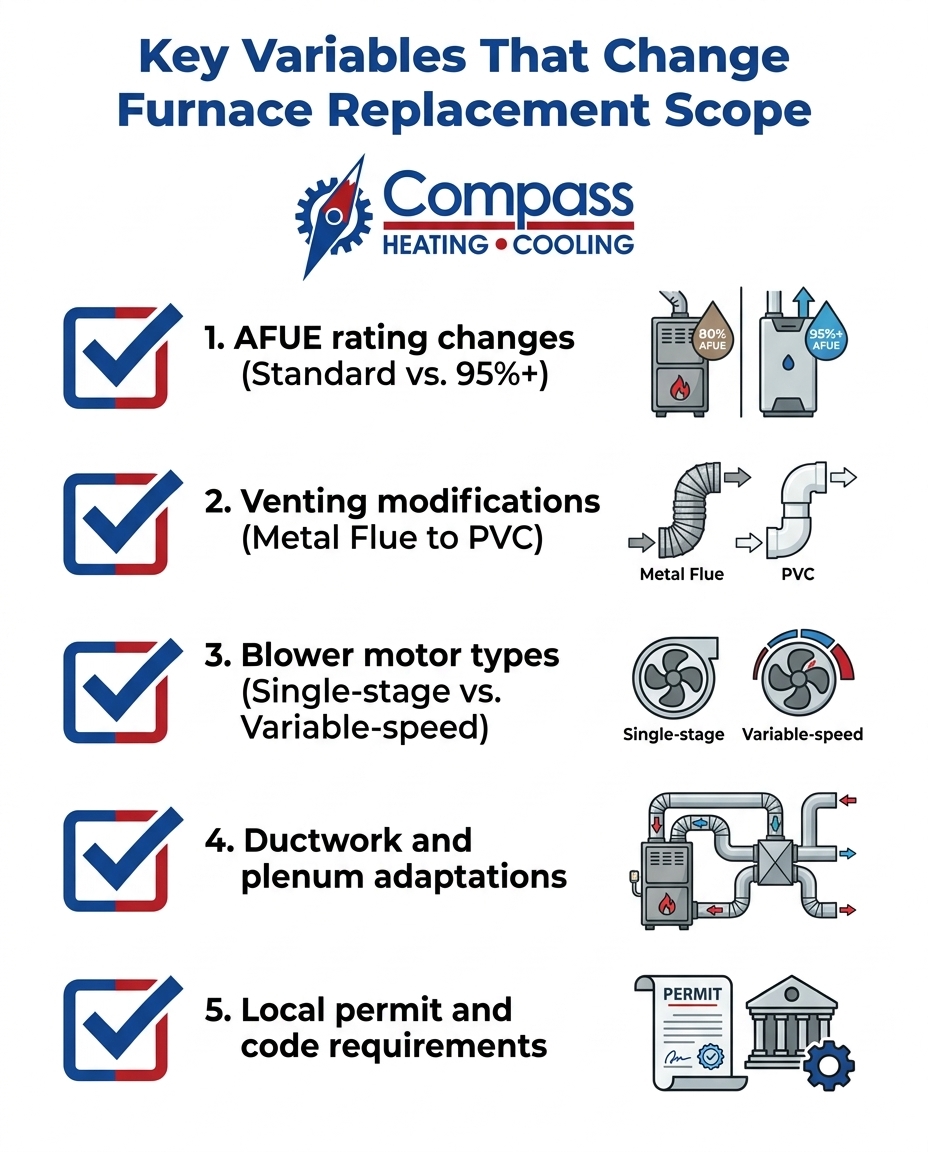
One of the biggest factors that alters the scope of your installation is the efficiency rating of the unit you choose. This is measured in AFUE, or Annual Fuel Utilization Efficiency. This rating tells you how much of the fuel your system consumes is actually converted into usable heat for your home. Choosing between high-efficiency vs. standard AFUE furnaces does more than just change your monthly energy use—it fundamentally changes the physical installation process.
Standard vs. High-Efficiency Units
Standard furnaces typically operate at about 80% AFUE. This means 80% of the fuel becomes heat, and 20% escapes as exhaust. High-efficiency furnaces, on the other hand, operate at 90% to 98% AFUE. To achieve this incredible efficiency, these advanced units use a secondary heat exchanger to pull additional heat from the combustion gases before they leave your home.
Because they extract so much heat, high-efficiency units require different physical dimensions, specialized venting, and specific drainage setups. Upgrading from an older 80% unit to a modern 95%+ unit is not a simple slide-in replacement; it requires a more involved mechanical setup.
• Heat Exchangers — Standard Efficiency (80% AFUE): Single primary heat exchanger — High-Efficiency (90%+ AFUE): Primary and secondary heat exchangers
• Exhaust Method — Standard Efficiency (80% AFUE): Traditional metal flue pipe — High-Efficiency (90%+ AFUE): Dedicated PVC piping
• Condensation — Standard Efficiency (80% AFUE): Minimal to none — High-Efficiency (90%+ AFUE): Produces liquid condensation requiring drainage
• Installation Scope — Standard Efficiency (80% AFUE): Often compatible with existing infrastructure — High-Efficiency (90%+ AFUE): Requires new venting and drain line routing
While generic utility incentive programs or federal tax credits may apply to high-efficiency units (always check with your local providers for current details), the initial labor scope is undeniably more intensive to accommodate the advanced technology.
Colorado Climate Considerations
Why does this matter so much for local homeowners? Freezing winter temperatures and heavy snow in the region make 95%+ AFUE furnaces a preferred standard for long-term comfort. When the temperature drops below zero, you need a system that maximizes every ounce of fuel. If you are planning a heating and furnace replacement, opting for high efficiency is often a functional necessity for consistent comfort, rather than just a luxury upgrade.
Venting Modifications: Transitioning to High-Efficiency
If you decide that high-efficiency vs. standard AFUE furnaces is the right choice for your home, the next major variable is venting. This is often the most surprising part of the installation process for homeowners, as it involves structural modifications to the house itself.
Metal Flues vs. PVC Venting
Older homes were built to accommodate standard-efficiency furnaces, which vent hot exhaust gases up through a traditional metal flue or chimney. Because the exhaust from an older furnace is very hot, it rises naturally and dissipates outside.
High-efficiency units are different. Because the secondary heat exchanger pulls almost all the heat out of the exhaust gas, the remaining exhaust is relatively cool. As it cools, it creates liquid condensation. This condensation is highly acidic and will quickly rust and destroy a traditional metal flue. Therefore, high-efficiency furnaces must be vented using specialized PVC pipes.
What a venting modification entails:
• Routing new pipes: Installers must route two new PVC pipes (one for fresh air intake, one for exhaust) from the furnace to the exterior of your home.
• Managing drainage: Because the system creates liquid condensation, a dedicated drain line must be routed to a floor drain or a specialized condensate pump.
• Sealing old flues: The existing metal chimney or flue must be safely capped off or adapted if it is still being used by a standard gas water heater.
Structural Considerations in Older Homes
Routing new PVC pipes through an older home can be a complex puzzle. It often requires navigating through finished basements, tight crawlspaces, or thick exterior walls. This structural modification is a primary driver of the project's overall scale. This is exactly why a transparent, upfront evaluation is so important. A thorough inspection identifies these venting needs before the work begins, ensuring there are no surprise modifications halfway through the installation.
Blower Motor Technology and System Compatibility
The furnace burner creates the heat, but the blower motor is what actually delivers that comfort to your living room. The type of blower motor you select is a critical variable in the overall installation scope, directly impacting your daily comfort and how the system interacts with your existing home infrastructure.
Single-Stage vs. Variable-Speed Blowers
When comparing high-efficiency vs. standard AFUE furnaces, you also have to look at how the air is distributed. There are two primary types of blower motors to consider:
• Single-Stage Motors: These take an all-or-nothing approach. When the thermostat calls for heat, the blower kicks on at 100% capacity, blasts hot air into the house until the target temperature is reached, and then shuts off completely. This can lead to noticeable temperature swings and drafty feelings.
• Variable-Speed Motors: These act more like the cruise control in your car. They can adjust their blowing capacity incrementally. They might run at 40% capacity to gently circulate air, ramping up only when the temperature drops significantly. This provides vastly superior temperature consistency and quieter operation.
Adapting to Existing Ductwork
One of the hidden benefits of a variable-speed blower is its ability to overcome less-than-ideal legacy ductwork. Many older homes have duct systems that are slightly undersized, or they feature long, restrictive runs to second-story bedrooms. A variable-speed motor can sense resistance (static pressure) in the ductwork and automatically adjust its torque to ensure the right amount of airflow reaches the furthest corners of the house. Upgrading to this technology is a major factor in the scope of your project, but it solves long-standing comfort issues that a basic single-stage motor cannot fix.
Ductwork Alterations and Airflow Requirements
A brand-new, top-of-the-line furnace cannot perform efficiently if it is connected to undersized, leaking, or damaged ductwork. Think of it like putting a high-performance sports car engine onto bicycle tires—the power is there, but the delivery system is fundamentally broken.
Assessing Existing Duct Health
During a professional installation estimate, technicians must assess the health of your existing ducts. For homes in Fort Collins and the Colorado Front Range, older ductwork often suffers from disconnected joints in the crawlspace or inadequate return-air sizing. If the new furnace requires more airflow than your old ducts can handle, the system will overheat, short-cycle, and wear down prematurely. Identifying these restrictions early means that necessary duct repairs or expansions are factored into the initial scope of work, rather than becoming an emergency repair later.
Custom Plenum and Transition Fabrication
Even if your main duct trunks are in perfect condition, the connection point between the new furnace and the old ducts almost always requires modification. Because modern furnaces are typically shorter and narrower than units built twenty years ago, they will not perfectly align with your existing sheet metal.
The fabrication process includes:
• The Supply Plenum: The large metal box sitting directly above the furnace must often be rebuilt to ensure an airtight seal.
• Return Air Drops: The ducting that brings cold air back to the furnace may need to be widened to accommodate larger, modern media filters.
• Custom Transitions: Installers use specialized sheet metal fabrication on-site to create smooth, angled transitions that reduce air turbulence and whistle noises.
Significant duct modifications and custom metalwork will naturally expand the scope of the installation project. If you are located in the Fort Collins heating service area, ensuring these transitions are airtight is vital for keeping your winter utility usage in check.
Timing Your Installation for Optimal Planning
The mechanical variables are only half the equation; the timing of your project is just as critical. Planning a furnace replacement is fundamentally different from reacting to a sudden breakdown.
The Advantage of Fall Preparation
The strategic advantage of scheduling your replacement during the transition months cannot be overstated. The September pre-heating season is the absolute best time to evaluate your system's scope. During this window, you have the luxury of time. You can carefully weigh the benefits of different AFUE ratings, schedule thorough ductwork assessments, and make a measured decision.
Conversely, if you wait until a deep freeze hits in late November and your old unit fails completely, you are forced into an emergency replacement. Emergency scheduling limits your equipment options to whatever is currently sitting on the warehouse shelf, and it drastically increases the stress of the situation. Proactive planning allows for a thorough assessment of all mechanical variables without a rushed timeline.
Managing Installation Timelines
Proactive scheduling also ensures that all custom parts, specialized PVC venting materials, and necessary municipal permits are secured seamlessly before the work begins. Furthermore, planning ahead gives you the space to explore flexible payment options. Managing the scope of a comprehensive mechanical upgrade through structured financing is often much more comfortable for local homeowners than facing an emergency, out-of-pocket expense in the middle of the holidays.
Frequently Asked Questions About Furnace Replacement Scope in Fort Collins
Understanding the full scope of a heating upgrade involves navigating local codes, mechanical requirements, and climate demands. Before pulling the trigger on a new system, many homeowners have questions about permits for installing HVAC and other regional requirements. Here are answers to the most common questions we see across Fort Collins and the Colorado Front Range.
What makes a high-efficiency furnace installation different?
The primary difference lies in the venting and drainage requirements. Because high-efficiency models extract more heat, they produce an acidic liquid condensation that must be safely drained away. Additionally, they cannot use traditional metal chimneys and require dedicated PVC pipes routed to the exterior of your home for fresh air and exhaust.
Why does my ductwork affect my furnace replacement?
Your ductwork acts as the lungs of your heating system, and modern furnaces require precise airflow to function properly. If your existing ducts are too small or heavily restricted, a new, powerful furnace will struggle to breathe, leading to overheating and premature failure. Modifying the ductwork ensures the new equipment operates safely and efficiently.
What are the requirements for furnace replacement in Fort Collins?
Local building codes dictate strict safety standards for gas line connections, electrical wiring, and exhaust venting. Municipalities require mechanical permits and final inspections to ensure the system is safely integrated into your home. A professional installation team handles this entire permitting process to keep your home compliant and safe.
Is a high-efficiency furnace worth it in Colorado?
Yes, the extreme temperature drops and long winters make high-efficiency units highly beneficial for the region. While the initial installation involves more labor to modify venting, the long-term reduction in fuel waste provides significant ongoing value. It ensures your home stays consistently comfortable even during the harshest January freezes.
Does replacing a furnace require new ductwork?
Not always, but it almost entirely depends on the condition and size of your current layout. While a complete whole-house duct replacement is rare, custom sheet metal modifications near the furnace itself (the plenum and return drop) are almost always required to ensure a perfect, airtight fit with the new equipment.
How do flexible payment options help manage replacement scope?
Flexible financing allows homeowners to choose the system that actually fits their home's mechanical needs, rather than compromising based on immediate out-of-pocket limits. It empowers you to address necessary ductwork repairs or opt for variable-speed technology upfront, breaking the total investment into manageable monthly increments.
Next Steps for Your Home Heating Upgrade
A clear understanding of these installation variables leads to a much better long-term investment for your home. By acknowledging that a furnace replacement is a complex mechanical integration rather than a simple box swap, you protect yourself from unexpected surprises and subpar performance. Whether you are dealing with older ductwork or deciding on the right AFUE rating for your specific layout, the details matter.
Working with a locally owned team means you get a focus on necessary, home-specific upgrades rather than generic upselling. We believe in transparent, upfront pricing and thorough evaluations before any tools are lifted. If you are living in Fort Collins and the Colorado Front Range and want to ensure your home is ready for the winter, the best step is proactive planning. Schedule a comprehensive inspection today to evaluate your unique mechanical needs and secure your comfort for the seasons ahead.
hear what our satisfied clients have to say
Our clients consistently praise our exceptional service and attention to detail. They appreciate the personalized approach we take to meet their unique needs, ensuring satisfaction every step of the way.
.png)