



The Proper Way to Switch Your System from Cooling to Heating

Surviving the September Temperature Swings
September in the Colorado Front Range marks the beginning of rapid fall temperature transitions, making it critical to know the proper way to switch your system from cooling to heating. During this unpredictable window, you might find yourself relying on air conditioning to stay comfortable during sunny afternoons, only to need a reliable furnace as nighttime temperatures edge toward freezing. Here at Compass Heating & Cooling, our team knows that navigating this shift requires more than just flipping a switch on your thermostat; it requires a proactive approach to protect your HVAC equipment from unnecessary strain.
If you need professional heating services to prepare for the cold, or want the peace of mind that comes with the Compass Club Maintenance Plan, our team is ready to help you transition smoothly.
The September to October transition is notoriously tricky for indoor climate control. We often see homeowners wait until the first major cold snap to discover their furnace is struggling, leading to uncomfortable nights and stressful emergency service calls. By taking safe, homeowner-appropriate steps to prepare your system now, you can verify that your heating equipment is fully operational before the freezing weather settles in. Proactive preparation gives you the ultimate peace of mind, ensuring your family stays warm without the last-minute panic.
The Danger of Waiting for the First Hard Freeze
Having served Loveland and the Colorado Front Range for years, our technicians know firsthand how extreme weather patterns can shift without warning. It is not uncommon for local temperatures to plummet 30 degrees or more in a single day. Sudden Chinook winds and early, unexpected freezes routinely catch homeowners off guard, transforming a mild autumn afternoon into a freezing winter night in a matter of hours.
When you wait for the first hard freeze to test your furnace, you are taking a significant gamble. If your system fails to ignite or blows cold air, you will instantly find yourself in a no-heat emergency. Unfortunately, this is the exact moment when hundreds of other unprepared homeowners discover their own equipment failures. Every fall, our dispatchers see this "first freeze rush" firsthand, which means that local HVAC companies are often fully booked for days, leaving you waiting in the cold.
Testing your system weeks before it is heavily relied upon is the most effective way to avoid this logistical nightmare. By identifying and resolving minor issues during the mild September to October transition, you secure priority scheduling and ensure your home remains safe and comfortable. If you discover a problem during your early test run, reaching out to experienced Loveland HVAC professionals immediately guarantees your system is repaired long before the first snowstorm hits.
Understanding Front Range Weather Volatility
The unique geography of the Front Range creates a volatile microclimate. As cold air masses move down from the mountains and clash with lingering late-summer warmth on the plains, the resulting temperature swings put immense pressure on residential HVAC systems. Your equipment is forced to cycle between cooling and heating modes rapidly, which can accelerate wear and tear if the system is not properly maintained. Anticipating these swings and preparing your system in advance is the key to extending the lifespan of your furnace and air conditioner.
Properly Retiring Your Air Conditioner for the Season
Before you even think about turning on your furnace, you must properly retire your air conditioning unit for the season. The physical transition from cooling to heating requires a deliberate process to ensure neither system is damaged. A pattern we see often is homeowners rushing this step during the September to October transition, which can lead to costly mechanical failures.
Clear the perimeter: Start by inspecting your outdoor condenser unit. Over the summer, grass clippings, dirt, and early falling leaves likely accumulated around the base and against the fins. Carefully clear away any summer debris to ensure the unit has at least two feet of unobstructed clearance. This prevents moisture buildup and protects the internal components from rust and winter damage.
Let the system rest: You should never immediately flip the thermostat switch from cool to heat. When your air conditioner has been running, the refrigerant inside the compressor is highly pressurized. Rapidly shutting off the AC and immediately demanding heat can confuse the system's control board and cause short-cycling. Always turn the thermostat to the "Off" position and let the system rest for at least five to ten minutes. This allows the internal pressures to equalize and the blower motor to come to a complete stop.
Address lingering issues now: If you noticed your AC struggling to keep up during August, or if it was making unusual noises, do not ignore those symptoms just because summer is ending. Addressing these problems through end-of-season AC maintenance ensures your cooling system is fully repaired and ready to perform flawlessly when the heat returns next spring.
Preparing Your Vents and Swapping Your Filters
Airflow management is the most critical factor in a successful seasonal transition. A furnace cannot operate safely or efficiently if it cannot breathe. Before you initiate any heating test, you must verify that the airpath is completely clear.
According to the US Department of Energy, replacing a dirty, clogged filter with a clean one can lower your system's energy consumption by 5% to 15%. During the summer months, your air filter works overtime capturing dust, pollen, and pet dander. Entering the heating season with a restricted filter forces your furnace blower motor to work twice as hard to push warm air through the house.
Restricted airflow is the leading cause of early-season furnace failures we encounter on service calls. When a furnace cannot push hot air out of the heat exchanger fast enough, the internal temperature of the unit spikes. This triggers the high-limit safety switch, causing the furnace to shut down prematurely to prevent a fire hazard. By simply starting the September to October transition with a fresh filter, you eliminate this common point of failure.
The Room-by-Room Airflow Checklist
Filters are only half of the airflow equation. You must also ensure that the warm air has a clear path into your living spaces. Walk through your home and check every single vent, register, and return grille.
• Floor Registers — Common Fall Obstructions: Rugs, seasonal decor, pet beds — Action Required: Ensure at least 18 inches of clearance above and around the vent.
• Wall Returns — Common Fall Obstructions: Bookshelves, newly rearranged furniture — Action Required: Move solid furniture away from the wall to allow air to be pulled back into the system freely.
• Ceiling Vents — Common Fall Obstructions: Closed louvers from summer — Action Required: Open all louvers fully. Closing vents in unused rooms damages the system by increasing static pressure.
The Proper Way to Switch Your System from Cooling to Heating
Managing your thermostat during the tricky fall transition weeks requires a strategic approach. When our technicians walk customers through the proper way to switch your system from cooling to heating, we emphasize that your thermostat settings dictate how hard your equipment has to work. Here is the exact method our team recommends for managing this transition in Loveland and the Colorado Front Range.
1. Turn the system to 'Off': As mentioned earlier, never switch directly from 'Cool' to 'Heat'. Move the selector switch to 'Off' and wait a minimum of five minutes. This protects the compressor and the blower motor from sudden, damaging voltage shifts.
2. Update your programmable schedules: Summer cooling schedules will not work for winter heating. Adjust your programmable or smart thermostat to reflect winter recommendations. The US Department of Energy suggests setting your thermostat to 68 degrees Fahrenheit during waking hours for optimal heating efficiency, and lowering it while you sleep or are away from home.
3. Manage the day-to-night fluctuations: During weeks with extreme temperature swings, avoid turning the system completely off during the day. Instead, rely on a moderate baseline temperature. If you need to understand the mechanics behind this, learning how a heat pump works for both heating and cooling in Colorado can help you optimize your settings for maximum efficiency without overworking the HVAC system.
4. Switch to 'Heat': Once the system has rested and your schedules are updated, move the selector switch to 'Heat'. Ensure the fan setting is on 'Auto' rather than 'On' so the blower only runs when the furnace is actively producing warm air.
How to Safely Test Your Heating System
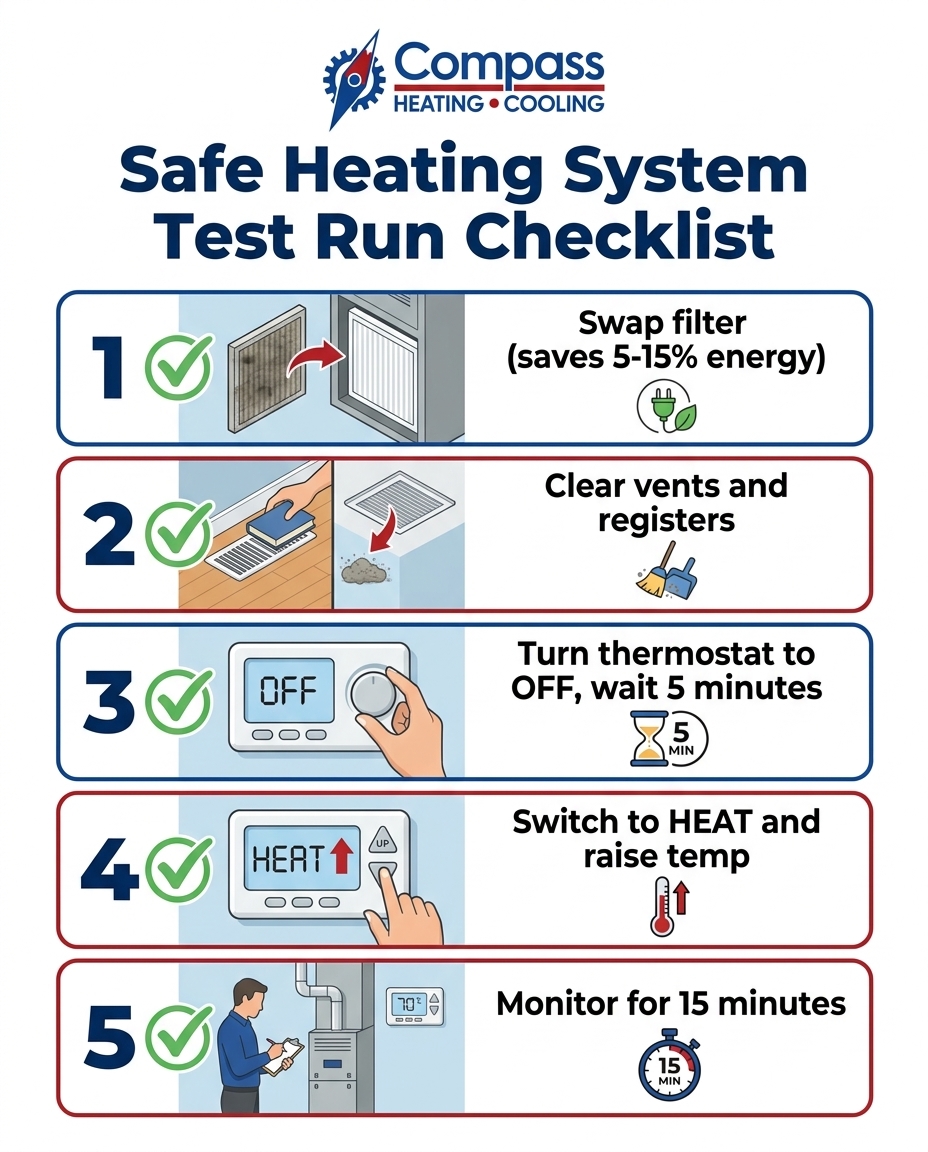
Executing a safe pre-freeze test run is the most important step of the September to October transition. This test allows you to verify operation in a controlled manner, long before you actually depend on the heat to keep your pipes from freezing.
1. Swap the air filter for a clean one: Never run a system test with a dirty summer filter in place.
2. Clear all vents and registers: Confirm that the airflow path is completely unobstructed throughout the entire house.
3. Switch the thermostat to 'Heat': Ensure the system has rested in the 'Off' position first.
4. Raise the temperature: Adjust the thermostat a few degrees above the current indoor room temperature to force the furnace to ignite.
5. Monitor the system for 15 minutes: Listen to the startup sequence. You should hear the inducer motor start, followed by the click of the ignitor, and finally the rush of the blower motor. Place your hand near a vent to ensure warm air is blowing consistently.
A note on early-season smells: When you run this test, you will likely notice a distinct burning dust smell. We assure our customers that this is completely normal for the first run of the season. Dust settles on the heat exchanger over the summer, and that dust burns off when the metal heats up. The smell should dissipate quickly within the first 15 to 30 minutes of operation.
When to Stop Testing and Call for Expert Help
While testing your system is a smart, proactive step, it is crucial to establish firm boundaries between safe homeowner maintenance and dangerous DIY repairs. Modern furnaces are complex pieces of equipment involving high-voltage electricity, combustible gases, and precise ventilation systems. If your test run reveals any abnormalities, you must stop testing immediately and call a licensed professional.
Identify the warning signs: A brief burning dust smell is normal, but a persistent smell of burning plastic, electrical ozone, or rotten eggs (gas) is a severe warning sign. Shut the system down immediately. Similarly, loud banging, grinding, or squealing noises indicate mechanical failure within the blower assembly or a delayed ignition issue. If the system fails to ignite entirely after a few attempts, do not repeatedly force it to try again, as this can allow unburned gas to pool.
• Light burning dust smell for 15 mins — Normal or Abnormal?: Normal — Next Steps: Allow system to run; open a window if necessary.
• Loud boom or bang upon startup — Normal or Abnormal?: Abnormal — Next Steps: Turn off system immediately; indicates delayed gas ignition.
• System runs for 2 minutes then shuts off — Normal or Abnormal?: Abnormal — Next Steps: Check for a dirty filter; if clean, call for service (short-cycling).
• Clicking sound but no warm air — Normal or Abnormal?: Abnormal — Next Steps: Turn off system; indicates a failed ignitor or flame sensor issue.
The dangers of DIY repairs: As licensed HVAC professionals, we cannot stress this enough: never attempt to open the furnace cabinet to clean the flame sensor, adjust the gas valve, or bypass safety switches. These actions require specialized training and diagnostic tools. Bypassing a safety switch can lead to catastrophic heat exchanger failure or carbon monoxide leaks.
The value of professional tune-ups: It is important to remember that a successful homeowner test run only confirms that the system turns on. It does not guarantee that the system is operating safely or efficiently. In our experience, professional tune-ups catch hidden, dangerous issues—like microscopic cracks in the heat exchanger or improper gas pressure—that a simple thermostat test run cannot detect. In Loveland and the Colorado Front Range, ensuring your system is professionally vetted is the only way to guarantee safety through the winter.
Secure Your Comfort Before the Cold Snaps
Taking the time to execute clear, safe, homeowner-appropriate steps today prevents stressful winter emergencies tomorrow. By properly resting your AC, swapping your filters, managing your thermostat transitions, and running a controlled test cycle, you protect your equipment from the rapid temperature swings of the September to October transition.
Our team at Compass Heating & Cooling encourages you to finalize your seasonal transition early so you are never caught off guard by a sudden freeze. The proper way to switch your system from cooling to heating always ends with a professional inspection. Explore our Compass Club Maintenance Plan to guarantee your heating system is safe, efficient, and fully prepared for whatever the Colorado winter brings.
Frequently Asked Questions
When should I switch from cooling to heating in Colorado?
The best time to switch is during the mild transition weeks of September and early October, before the first hard freeze hits. Monitoring the forecast for consistent nighttime temperatures dropping below 50 degrees is a good indicator that it is time to transition. Testing early ensures you have time to schedule professional repairs if needed.
How do I test my furnace before winter?
To test your furnace, start by replacing the air filter and ensuring all household vents are open and unblocked. Turn your thermostat to 'Off' for five minutes, then switch it to 'Heat' and raise the temperature a few degrees above the room's current ambient temperature. Let it run for 15 minutes to confirm that warm air is blowing consistently from the registers.
What is the proper way to switch a thermostat from cool to heat?
The proper way is to first move the thermostat switch to the 'Off' position and wait at least five to ten minutes. This waiting period allows the refrigerant pressures in your air conditioner to equalize and prevents the system from short-cycling. Once the system has rested, you can safely move the switch to 'Heat' and adjust your temperature schedule.
Should I turn off my AC before turning on the heat?
Yes, you must always turn off the AC and allow the entire HVAC system to rest before initiating the heating cycle. Instantly flipping the switch from cooling directly to heating can cause electrical strain on the control board and damage the compressor. A brief five-minute rest period in the 'Off' position is all that is required to protect your equipment.
What temperature should I set my thermostat in the fall?
The US Department of Energy recommends setting your thermostat to 68 degrees Fahrenheit during waking hours for optimal balance between comfort and energy efficiency. During the fall, you can lower the temperature by 7 to 10 degrees while you are sleeping or away from home to further reduce your energy consumption without overworking the furnace when it recovers.
Is it normal for my heater to smell the first time I turn it on?
Yes, it is completely normal to notice a burning dust smell during the first 15 to 30 minutes of your initial test run. Dust accumulates on the furnace's heat exchanger during the idle summer months, and this dust safely burns off when the metal heats up. However, if the smell persists for hours or smells like burning plastic or electrical ozone, shut the system down and call a professional.
hear what our satisfied clients have to say
Our clients consistently praise our exceptional service and attention to detail. They appreciate the personalized approach we take to meet their unique needs, ensuring satisfaction every step of the way.
.png)