



Everything You Need to Know About Deciding When to Repair vs Replace Your AC in Northern Colorado

When Is AC Repair in Northern Colorado Too Much — and Replacement the Smarter Move?
Knowing how much AC repair is too much before replacing your unit in Northern Colorado can save you from pouring money into a system that's already on its last legs. The short answer: if your repair costs are climbing toward half the price of a new unit — or if your system is 12 years or older and breaking down repeatedly — replacement usually wins.
Quick Answer: Repair vs. Replace Your AC in Northern Colorado
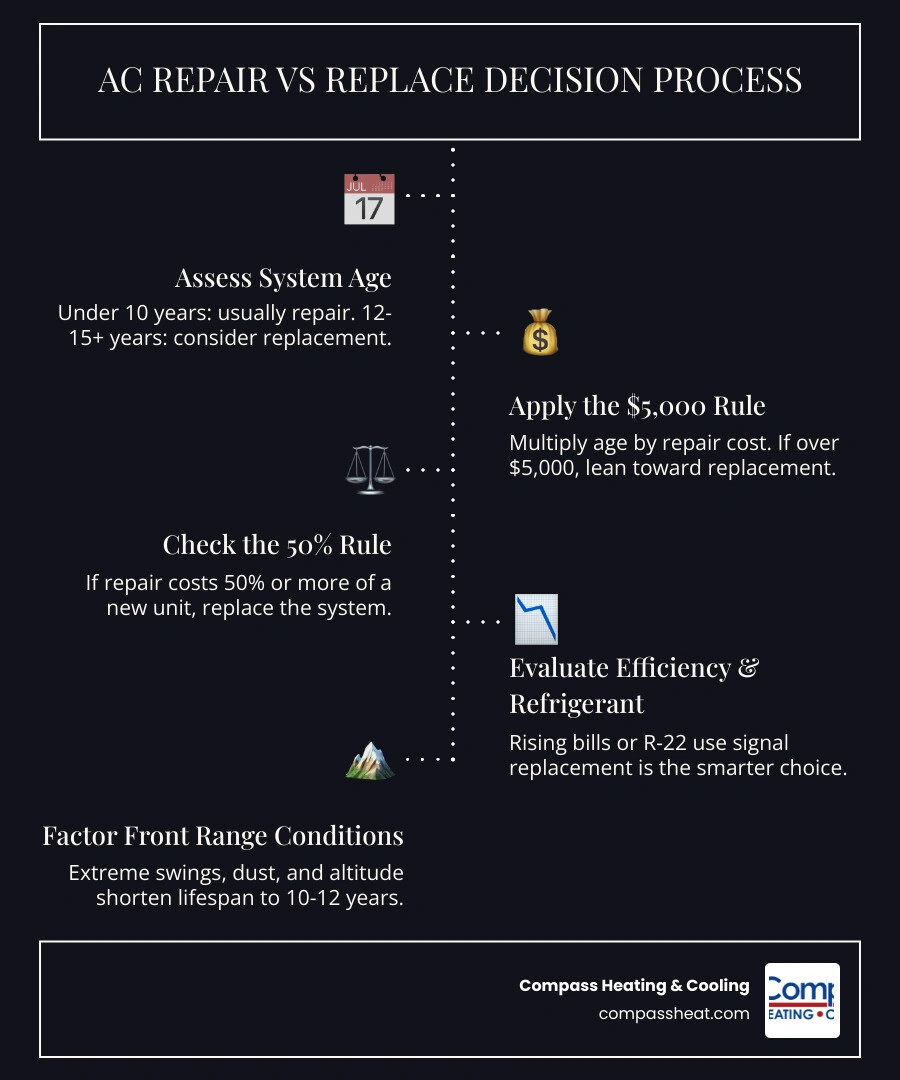
- Apply the $5,000 Rule: Multiply your AC's age (in years) by the estimated repair cost. If the result is over $5,000, lean toward replacement.
- Apply the 50% Rule: If a single repair costs 50% or more of a new system's price, replacement is almost always the better investment.
- Unit under 10 years old + minor repair: Repair it.
- Unit 12–15+ years old + major repair: Start pricing replacements.
- System uses R-22 refrigerant: Replace it — R-22 is no longer produced and recharges are increasingly impractical.
- Energy bills rising 15–25% with no change in usage: Your system is losing efficiency fast.
- Multiple major repairs in the past 2–3 years: That pattern signals broader system decline, not isolated bad luck.
Northern Colorado's climate makes this decision harder than average. The Front Range's extreme temperature swings, low humidity, high altitude, and agricultural dust push AC systems harder than in most other parts of the country. What lasts 15–20 years in a milder climate may only hold up 10–12 years here — sometimes less without consistent maintenance.
This guide walks you through exactly how to evaluate your situation, so you can stop guessing and make a confident, informed decision.
Discover more about how much ac repair is too much before replacing your unit in northern colorado:
- ac repair vs replace — decision guide for northern colorado
- is a 12 to 15 year old ac worth fixing in a northern colorado home
How Much AC Repair Is Too Much Before Replacing Your Unit in Northern Colorado?
Deciding whether to sink more money into your current cooling system or invest in a brand-new setup is a classic homeowner dilemma. In places like Fort Collins, Loveland, and Greeley, our summers are short but intense. When the July heat waves roll off the plains, a broken air conditioner quickly transitions from a minor annoyance to an absolute emergency.
To help you navigate this crossroads, we use a structured AC Repair vs Replace Decision Guide for Northern Colorado to weigh the pros and cons of each path.
Repair vs. Replacement Indicators
| Factor | When to Choose AC Repair | When to Choose AC Replacement |
|---|---|---|
| System Age | Under 10 years old | 12 to 15+ years old |
| Refrigerant Type | Modern R-410A (or newer) | Phased-out R-22 (Freon) |
| Repair Frequency | First major issue in several years | Multiple service calls over the last 2–3 seasons |
| Utility Bills | Stable, matching seasonal changes | Unexplained spikes of 15% to 25% |
| Comfort Levels | Consistent cooling throughout the home | Uneven temperatures and weak airflow |
| Warranty Status | Active manufacturer parts warranty | Expired warranty coverage |
When evaluating these indicators, we look closely at the financial threshold and the "repair-to-replacement ratio." If a single repair bill or the cumulative cost of fixing your system over the last two years approaches a significant portion of what a new, high-efficiency system would cost, you are likely throwing good money after bad. Investing in a replacement ensures you get a clean slate, complete with a fresh manufacturer warranty and years of worry-free operation.
Calculating How Much AC Repair Is Too Much Before Replacing Your Unit in Northern Colorado
To remove the guesswork from this process, the HVAC industry relies on a simple mathematical formula known as the $5,000 Rule. This rule acts as an objective financial decision tool, helping you calculate whether a repair makes long-term economic sense.
The calculation is straightforward:System Age (in years) × Estimated Repair Cost = Your Score
If your calculated score is under 5,000, repairing the unit is generally the more sensible choice. If the score is over 5,000, the math strongly favors replacing the unit.
Let's look at how this plays out in real-world Northern Colorado scenarios:
- Scenario A (The Greeley Homeowner): You have a 7-year-old AC unit that needs a new capacitor. The repair cost is relatively minor. Multiplying 7 years by this minor repair cost yields a score well below the 5,000 threshold. Our Recommendation: Repair the unit. It is still well within its expected lifespan and has plenty of good years left.
- Scenario B (The Loveland Homeowner): You have a 14-year-old air conditioner that needs a new blower motor. Multiplying 14 years by this moderate-to-high repair cost results in a score that easily clears 5,000. Our Recommendation: Replace the unit. Spending money on a system at the end of its life cycle rarely pays off, as other aging components are likely to fail soon after.
While the $5,000 Rule is an excellent baseline, it is important to look at the overall trend. If a system is in the "gray zone" but has a history of frequent breakdowns, the cumulative investment value of a new unit becomes even more attractive.
The 50% Rule for Major Component Failures
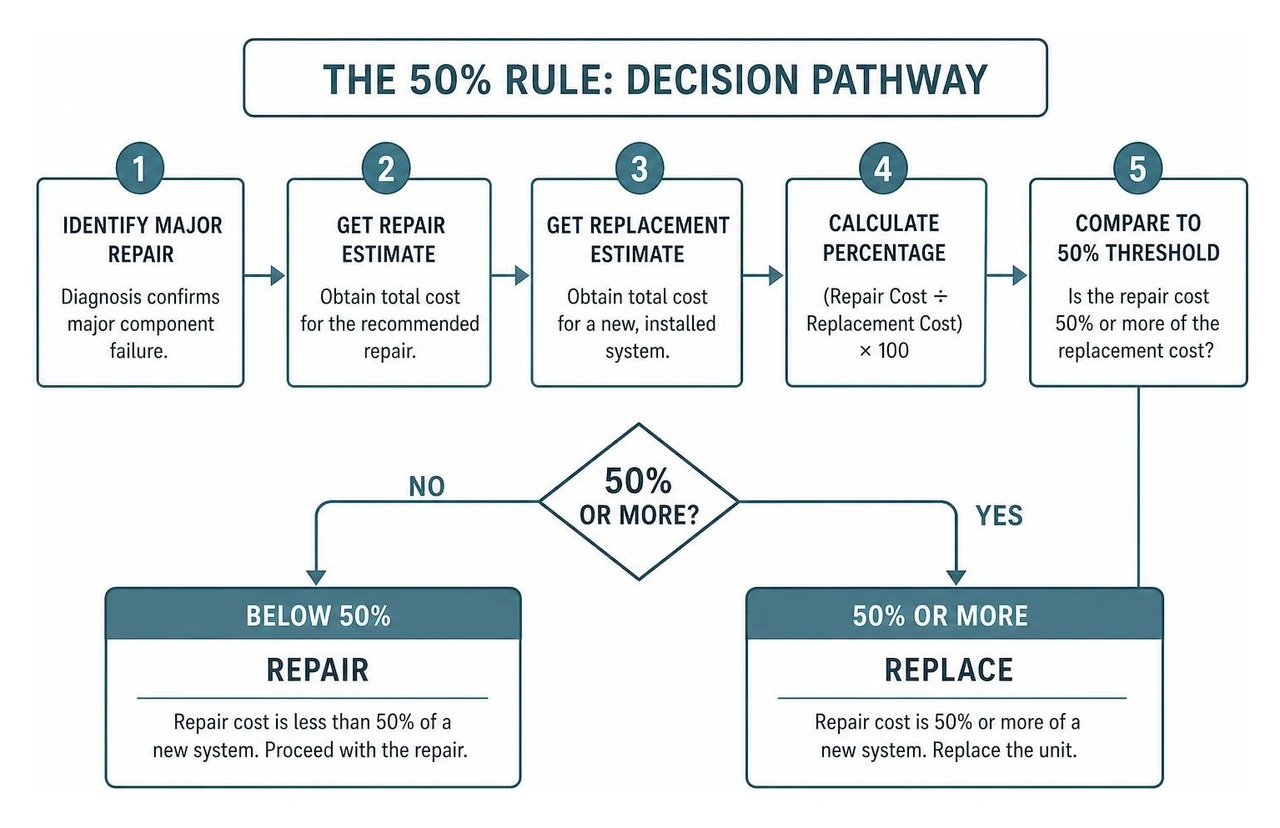
Another reliable benchmark we use is the 50% Rule. Simply put, if the cost of a single repair meets or exceeds 50% of the cost of installing a brand-new air conditioning system, you should almost always choose replacement.
Major component failures are the most common culprits that trigger the 50% Rule. Some of the most critical warning signs of a failing AC system that point to major component trouble include:
- Compressor Failure: The compressor is the heart of your air conditioner. If it fails on an older system, replacing it is incredibly labor-intensive and expensive, making a full system replacement the logical choice.
- Leaking Evaporator Coils: Over time, the copper coils can corrode and develop tiny pinhole leaks. Replacing these coils is a major undertaking that often makes little sense on an out-of-warranty unit.
- Burnt-Out Condenser Fan Motor: While sometimes repairable, if the motor fails in tandem with other electrical issues on an aging system, it is a clear sign of systemic wear.
Age and Lifespan Considerations for Front Range Air Conditioners
Understanding the Average Lifespan of a Central Air Conditioner in a Hot, Dry Front Range Climate is essential when weigh your options. While an air conditioner in milder, more humid parts of the country might easily coast past the 15-year mark, our unique local climate subjects outdoor condenser units to intense thermal stress, high UV exposure, and heavy wind-blown dust.
As a result, a central air conditioner in Northern Colorado typically has an operational lifespan closer to 12 to 15 years. Neglected systems or builder-grade units installed in rapid-growth subdivisions may even begin to show severe system degradation and loss of operational efficiency around the 10-year mark.
Evaluating Systems Under 10 Years Old
If your air conditioner is under a decade old, it is almost always a prime candidate for a professional Air Conditioning Repair. At this stage in its lifespan, the system's core components are usually robust, and there is a high probability that the unit is still covered by an active manufacturer parts warranty.
For systems in this age bracket, we frequently resolve issues with minor, highly cost-effective fixes, such as:
- Capacitor Replacement: Capacitors act like temporary batteries that help start the system's motors. They are highly susceptible to summer heat spikes but are quick and straightforward to replace.
- Thermostat Calibration: Sometimes, a system that seems to be failing simply has a faulty or miscalibrated thermostat that isn't communicating correctly with the outdoor unit.
- Contactor and Relay Fixes: Electrical contacts can wear down or get dirty over time, preventing the outdoor unit from turning on. Cleaning or replacing these parts restores full functionality quickly.
By addressing these minor issues early, you protect the system from secondary damage and keep it running efficiently for its remaining years.
Is a 12 to 15-Year-Old AC Worth Fixing?
When a system enters the 12 to 15-year window, the decision-making landscape shifts dramatically. If you find yourself asking Is a 12 to 15 Year Old AC Worth Fixing in a Northern Colorado Home, you must carefully consider the end-of-life cycle.
At this age, an air conditioner has endured over a decade of extreme Colorado winters and blazing summers. The cumulative wear and tear on the compressor, fan motors, and electrical relays means that fixing one part often simply transfers the operational stress to the next weakest link.
Homeowners with systems in this age range frequently experience a cascade of breakdowns. You might fix a contactor in June, only to have the fan motor fail in July, followed by a refrigerant leak in August. When you add up the cumulative repair costs, the hassle of multiple service calls, and the constant anxiety of whether your system will survive the next hot weekend, a planned replacement becomes the far more practical and stress-free option.
Environmental and Regulatory Factors Impacting Your Decision
Beyond the physical age and condition of your air conditioner, a variety of external environmental regulations, sustainable cooling standards, and state laws should influence your decision. The regulatory landscape for heating and cooling systems is changing rapidly, particularly here in Colorado.
Climate Factors: How Much AC Repair Is Too Much Before Replacing Your Unit in Northern Colorado?
Our local geography plays a massive role in how our HVAC systems wear down. Northern Colorado locations like Windsor, Severance, and Timnath sit at high altitudes, where the air is thinner and UV radiation is exceptionally intense.
- Altitude Effects: Because the air is less dense, your outdoor condenser has to work harder to transfer heat away from your home. This constant extra effort accelerates mechanical wear.
- Low Humidity: While low humidity makes our hot days more bearable, it causes building materials and ductwork to dry out, shrink, and crack over time. If your home has leaky ducts, your AC has to work up to 20% to 30% harder to maintain comfort.
- Agricultural Dust: In communities like Greeley, Evans, and Johnstown, agricultural dust and seasonal pollen frequently clog the delicate aluminum fins of outdoor condenser coils. If these coils aren't cleaned regularly, the system operates under high pressure and elevated temperatures, leading to premature compressor failure.
- Extreme Temperature Swings: The Front Range is famous for wild temperature swings. Rapid thermal cycling—going from a chilly spring morning to a hot afternoon—causes metal components in your AC to expand and contract rapidly, putting extra stress on soldered joints and electrical connections.
Refrigerant Phase-Outs: R-22 and R-410A Transitions
One of the most decisive factors in the repair-vs-replace debate is the type of refrigerant your system uses. If your air conditioner was installed before 2010, there is a very high chance it uses R-22 refrigerant (commonly known as Freon).
As part of environmental compliance efforts to protect the ozone layer, the EPA completely banned the production and import of R-22. Because of this phase-out, servicing an R-22 system that has developed a refrigerant leak is incredibly difficult and cost-prohibitive.
Furthermore, the industry is currently transitioning away from R-410A (the refrigerant that replaced R-22) in favor of newer, more environmentally friendly alternatives with lower global warming potential. If you have an older R-410A system that has developed a major leak, investing in a repair is often unwise. Upgrading to a modern system ensures you are compliant with the latest environmental standards and guarantees that your system can be easily and affordably serviced for decades to come.
Energy Efficiency Ratings and SEER2 Standards
If you are tired of watching your utility bills spike every summer, upgrading to a modern system is one of the most effective ways to take control of your energy consumption. To help you compare your options, we recommend reviewing our Top AC Replacement Options: A Comprehensive Brand Comparison.
Air conditioner efficiency is measured by the Seasonal Energy Efficiency Ratio (SEER), which was recently updated to the stricter SEER2 standard.
- Older Systems: Many systems installed 10 to 15 years ago operate at efficiency ratings as low as 8 to 10 SEER. Over time, these systems degrade further, sometimes dropping to an effective rating of 6 SEER.
- Modern SEER2 Systems: Today's minimum standard in Colorado is 14 SEER2, with high-efficiency variable-speed systems reaching ratings well over 20 SEER2.
- Variable-Speed Technology: Unlike older systems that turn on at 100% capacity and shut off repeatedly (causing temperature swings and high energy use), modern variable-speed compressors run continuously at lower, highly efficient speeds. This maintains a perfectly consistent temperature, lowers indoor humidity, and can reduce your cooling-related energy consumption by 20% to 50%.
Frequently Asked Questions About AC Repair vs. Replacement
How long does a central air conditioner typically last in Northern Colorado?
Due to our unique Front Range climate—characterized by high altitude, intense UV rays, low humidity, and wind-blown agricultural dust—a central air conditioner typically lasts 12 to 15 years. Systems that receive annual professional maintenance can sometimes push past 15 years, while neglected systems or those subjected to heavy dust loads in areas like Greeley and Severance may begin to fail closer to 10 years.
Should I replace my furnace at the same time as my air conditioner?
In most cases, yes, replacing them together is highly recommended. Your furnace and air conditioner share the same blower motor and duct system. When you install a matched system, you ensure that both components are designed to work together at peak efficiency. Additionally, combining the installations allows you to take advantage of shared labor savings, minimizing installation disruptions and reducing overall labor fees compared to doing the projects separately.
What are the warning signs of a failing compressor?
The compressor is the most critical and expensive component of your AC system. Clear warning signs of impending failure include:
- Loud, unusual noises: Squealing, clattering, or grinding sounds when the outdoor unit starts up.
- Hard starting: The outdoor unit shudders, hesitates, or trips your home's electrical breaker when trying to turn on.
- Reduced cooling capacity: The system runs constantly but only blows lukewarm or slightly cool air from your vents.
- Frequent electrical trips: The system repeatedly shuts down due to drawing too much electrical current.
Conclusion
Determining how much AC repair is too much before replacing your unit in Northern Colorado doesn't have to be a stressful guessing game. By applying objective frameworks like the $5,000 Rule and the 50% Rule, and carefully considering your system's age, refrigerant type, and the local climate challenges of the Front Range, you can make a smart, financially sound choice for your home.
At Compass Heating & Cooling, we are dedicated to helping homeowners in Fort Collins, Loveland, Windsor, Wellington, Severance, Timnath, Johnstown, Greeley, Berthoud, and Evans find the perfect balance between comfort and value. We take the hassle out of upgrading by handling all local utility rebates for you—helping you secure up to $8,000+ in eligible incentives to significantly offset the cost of a new, high-efficiency system.
Additionally, our comprehensive maintenance plan offers priority scheduling, valuable discounts, and the peace of mind that comes with regular professional care to extend the life of your equipment.
Before you commit to another temporary fix, let us provide you with an honest, transparent diagnostic assessment. Contact us today to schedule your system evaluation and find out how we can keep your home cool and comfortable all summer long.
Explore our professional Air Conditioning Repair services and let our expert team guide you toward the best solution for your home.
hear what our satisfied clients have to say
Our clients consistently praise our exceptional service and attention to detail. They appreciate the personalized approach we take to meet their unique needs, ensuring satisfaction every step of the way.
.png)