



Why Cracked Heat Exchangers Are the Most Dangerous Hidden Furnace Defect
The Invisible Threat Lurking in Your Fall Furnace Prep
You turn on your thermostat for the first chilly morning of the September pre-heating season, expecting warm air, but you might also be circulating a hidden hazard. At Compass Heating & Cooling, we constantly remind our Loveland customers that understanding exactly why cracked heat exchangers are the most dangerous hidden furnace defect is critical before the cold weather truly settles in. Every year, homeowners diligently swap out their air filters, dust off their vents, and assume their heating system is ready for the months ahead. However, the most critical component of your furnace operates entirely out of sight, acting as the sole barrier between toxic combustion gases and the breathable air inside your home.
This barrier is the heat exchanger, a series of metal tubes or coils that absorb heat from the burner flames and transfer it to the air blowing through your ducts. As furnaces age, they develop microscopic metal fatigue fractures that are completely invisible to the naked eye. A fresh air filter provides a false sense of security against this specific structural failure. You need a comprehensive evaluation of your HVAC systems to detect these hairline cracks before the first major cold snap forces your equipment into continuous operation.
The False Security of Surface-Level Maintenance
Many homeowners believe that if the furnace turns on and produces heat, everything is functioning perfectly. In our years of servicing local homes, we have found this to be a dangerous misconception. A furnace with a compromised heat exchanger will often continue to heat your home just fine. The thermostat clicks, the burners ignite, and warm air flows from the registers. The mechanical function of heating masks the chemical danger of combustion gas leakage.
Because these fractures start at a microscopic level, they do not immediately cause the system to shut down. Instead, they create a slow, silent breach. Relying solely on basic homeowner upkeep leaves this critical safety barrier unchecked. The transition into fall is the exact moment our team recommends addressing this, ensuring that the air circulating through your living spaces remains clean, safe, and free of exhaust fumes.
The Physics of Metal Fatigue: How Heat Exchangers Crack
To understand why these components fail, you have to look at the extreme physical stress they endure every single day. The heat exchanger does not crack because it is inherently defective; it cracks because of the unavoidable physics of thermal expansion and contraction. Over years of heavy use, the metal simply tires out.
Think of this process like bending a metal paperclip back and forth. If you bend it once or twice, it holds its shape. If you bend it rapidly fifty times, the metal heats up, weakens, and eventually snaps. Your furnace undergoes a similar stress test, just on a larger scale and over a longer timeline. In our experience working across Loveland CO, where average winter lows regularly drop into the teens, furnaces are forced to run heavily for months on end. This intense, prolonged heating demand maximizes the thermal stress on the metal, drastically accelerating the fatigue cycle.
The Thermal Stress Cycle
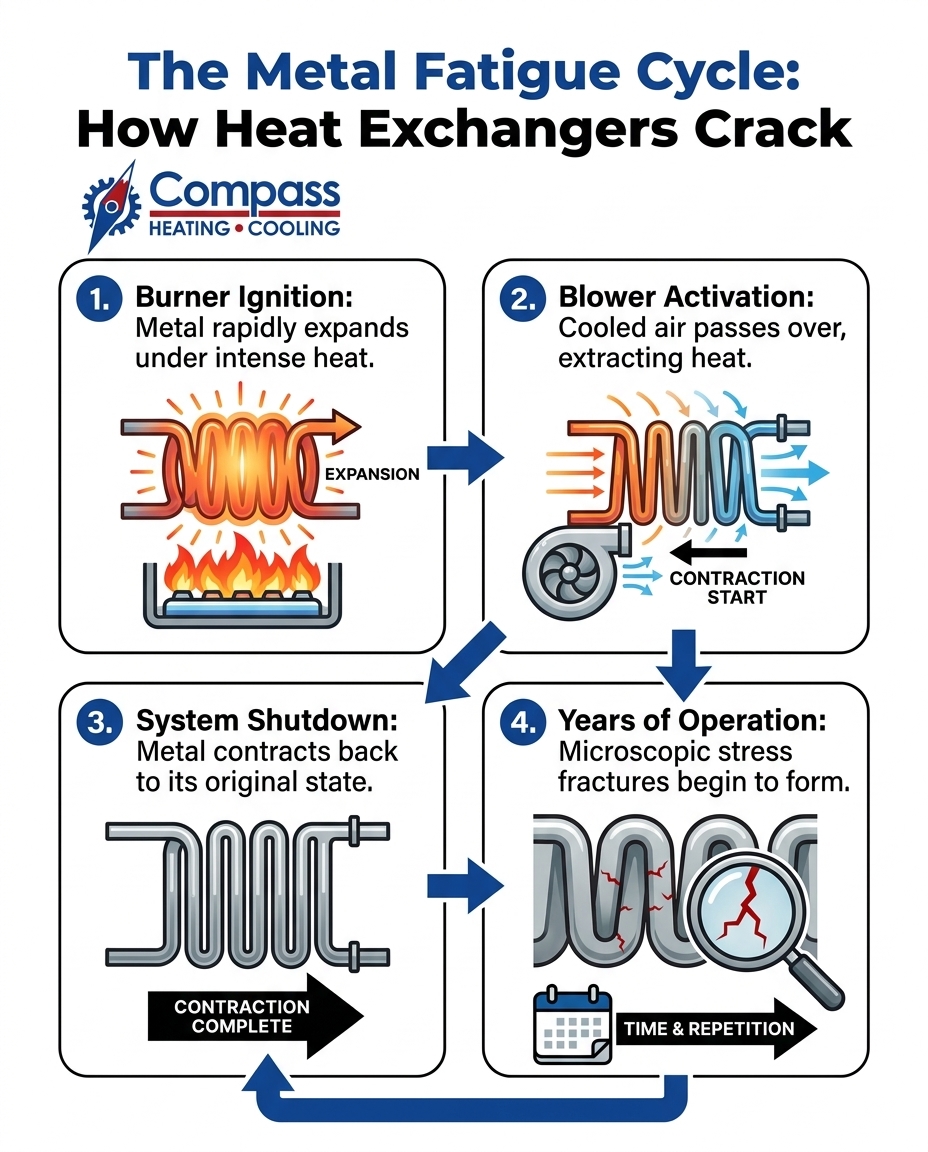
The wear and tear on this component happens in a predictable, multi-stage cycle every time your thermostat calls for heat:
1. Burner Ignition and Rapid Expansion: When the furnace kicks on, the burners blast intense heat directly into the metal chambers of the heat exchanger. The metal rapidly heats up and physically expands.
2. Blower Activation and Heat Transfer: Shortly after ignition, the blower fan activates. It pushes cold return air over the outside of the hot metal chambers. The air absorbs the heat, cooling the exterior of the metal while the inside remains blasted by fire.
3. System Shutdown and Contraction: Once your home reaches the desired temperature, the burners shut off. As the metal cools down, it contracts back to its original size and shape.
4. Cumulative Structural Weakening: Over a decade or more of operation, this constant swelling and shrinking causes the metal at the weakest points—usually the curves and welded seams—to become brittle and fracture.
• Mild Winter Usage — Impact on Heat Exchanger Metal: Gradual expansion and contraction cycles. — Long-Term Result: Normal lifespan, typically 15-20 years before fatigue sets in.
• Harsh Loveland Winters — Impact on Heat Exchanger Metal: Continuous, rapid cycling with extreme temperature differentials. — Long-Term Result: Accelerated metal fatigue, increasing the risk of early microscopic fractures.
• Restricted Airflow (Dirty Filters) — Impact on Heat Exchanger Metal: Metal overheats due to lack of cooling airflow, expanding beyond design limits. — Long-Term Result: Premature cracking and potential system failure long before the expected lifespan.
Why Basic Maintenance Misses Microscopic Fractures
Homeowners often wonder why they cannot just check the heat exchanger themselves. The short answer is that the component is buried deep within the furnace cabinet, completely inaccessible without professional disassembly. You cannot simply open the front panel of your furnace and see the entire structure. It is a complex labyrinth of metal tubes or clamshell-shaped chambers hidden behind the blower motor and burner assembly.
Furthermore, early-stage cracks are incredibly deceptive. Because metal expands when heated, a microscopic fracture might only open up while the burners are firing at maximum capacity. When the furnace is turned off and the metal is cold, the crack shrinks and closes tight, rendering it practically invisible to a standard flashlight inspection. This is exactly why our team insists that scheduling routine furnace maintenance with trained experts is non-negotiable for aging systems.
The Danger of DIY Disassembly
Attempting to dismantle your furnace to look for cracks is highly dangerous. Interacting with combustion chambers, gas lines, and high-voltage electrical components requires a licensed professional. Reassembling a furnace incorrectly can create gas leaks or disrupt the precise airflow required for safe combustion.
Professional evaluations go far beyond a visual glance. Our technicians understand exactly where specific furnace models tend to stress and fracture. We know how to inspect the serpentine curves and rear panels that a homeowner cannot reach. Comprehensive evaluations remain the only definitive way to verify the structural integrity of this vital safety barrier.
The Carbon Monoxide Connection: A Severe Safety Risk
The primary reason a cracked heat exchanger is considered a critical defect comes down to one substance: carbon monoxide (CO). Inside a healthy furnace, the toxic gases created by burning fuel are contained entirely within the heat exchanger and routed safely out of your home through the exhaust flue. The breathable air from your home blows over the outside of these sealed tubes, warming up without ever touching the exhaust.
When a crack forms, that impenetrable seal is breached. According to the CDC, carbon monoxide is an odorless, colorless gas responsible for over 400 deaths and 100,000 emergency room visits annually. It is a silent threat because human senses cannot detect it. You cannot smell it, taste it, or see it.
How the Blower Fan Becomes a Delivery System
The mechanics of your furnace actually worsen the danger of a cracked heat exchanger. The powerful blower fan that pushes warm air into your living room creates pressure changes inside the cabinet. As air rushes past the cracked metal, it can disrupt the draft inside the combustion chamber.
This pressure differential can pull toxic exhaust gases out through the fracture and directly into the clean airstream. From there, your ductwork acts as a high-speed delivery system, distributing carbon monoxide into every bedroom, hallway, and living space in the house.
Physical symptoms of low-level CO exposure include:
• Persistent headaches: Often described as a dull, frontal tension that clears up when you leave the house.
• Dizziness and disorientation: A feeling of lightheadedness or confusion that worsens the longer the furnace runs.
• Nausea and fatigue: General lethargy and stomach upset.
Because these symptoms closely mirror the seasonal flu, many families dismiss them during the winter months, unknowingly remaining in a hazardous environment. This is why preventing the leak before it starts is paramount.
Late-Stage Warning Signs of Heat Exchanger Failure
While microscopic cracks are invisible, a severe, advanced fracture will eventually produce physical evidence. Educating yourself on these late-stage warning signs is vital, but our technicians at Compass Heating & Cooling always stress that waiting for these signs to appear is incredibly dangerous. If you observe any of the following symptoms, your system has already been compromised for quite some time.
• Changes in the burner flame: A healthy gas furnace produces a crisp, steady blue flame with perhaps a tiny tip of yellow. If you look through the viewing portal and see a dancing, lazy, entirely yellow or orange flame, it indicates a severe problem. A cracked heat exchanger allows the blower fan to push air into the combustion chamber, altering the oxygen mix and disrupting the flame.
• Soot buildup inside the cabinet: Incomplete combustion, often caused by the draft interference mentioned above, creates black soot. If you notice a powdery black substance building up around the furnace exterior, on the burners, or near your air registers, it is a glaring red flag.
• Unusual, chemical odors: While carbon monoxide itself is odorless, the other byproducts of incomplete combustion are not. A strong, sharp smell resembling formaldehyde or a harsh metallic odor coming from your vents when the heat kicks on can accompany a breached heat exchanger.
• Water pooling on the floor: For high-efficiency condensing furnaces, a cracked secondary heat exchanger can leak acidic condensation onto the floor around the base of the unit.
If any of these signs are present, the system must be shut down immediately. Do not run the furnace "just for the night." Secure your safety first, and then look into getting a second opinion on a condemned furnace to confirm the diagnosis and explore your replacement options. If a replacement is necessary, keep in mind that generic utility incentive programs or federal tax credits may apply to qualifying high-efficiency installations, though it is always best to verify current programs with your utility provider or a tax professional.
Advanced Diagnostic Tools: Catching Defects Before the Freeze
Because basic visual inspections fail to catch early-stage metal fatigue, professionals rely on advanced diagnostic technology. This is the bridge between suspecting a problem and proving it with hard data. Modern HVAC diagnostics have evolved far beyond shining a flashlight into a dark metal box.
Working with Loveland heating professionals means you benefit from meticulous safety inspections and expert diagnostics. When our team at Compass Heating & Cooling visits your home, our technicians utilize specialized tools designed specifically to uncover hidden defects long before they trigger a wall alarm or cause a mid-winter breakdown.
High-Tech Inspection Methods
Two primary tools are used to verify the integrity of a heat exchanger:
• High-Definition Infrared Inspection Cameras: These flexible, fiber-optic cameras are navigated directly into the complex curves of the heat exchanger. They provide a brightly lit, high-resolution view of the innermost chambers, allowing technicians to spot hairline fractures, rust pitting, and stress marks that are otherwise completely hidden from view.
• Combustion Analyzers: This sensitive equipment measures the exact chemical composition of the exhaust gases and the ambient air in the ductwork. By analyzing the parts-per-million (PPM) of carbon monoxide and oxygen, technicians can detect trace amounts of CO escaping into the airstream—often long before the crack is large enough to be seen.
These specialized tools provide definitive, data-backed safety testing. They remove the guesswork from furnace maintenance, giving homeowners absolute peace of mind that their system is structurally sound and safe to operate.
Frequently Asked Questions About Heat Exchanger Safety
What causes a cracked heat exchanger?
The primary cause of a cracked heat exchanger is metal fatigue from years of thermal stress. Every time the furnace runs, the intense heat causes the metal to expand, and it contracts again when the cycle ends. Over thousands of cycles, especially during harsh winters, this constant movement causes the metal to weaken, become brittle, and eventually fracture at its stress points.
Why is a cracked heat exchanger dangerous?
A cracked heat exchanger is dangerous because it breaches the sealed barrier between toxic combustion exhaust and your home's breathing air. This allows carbon monoxide and other harmful gases to be pulled into the ductwork by the blower fan. Once in the ducts, these toxic, odorless gases are distributed throughout your living spaces, posing a severe health and safety risk.
Can I see a cracked heat exchanger myself?
In most cases, you cannot see a cracked heat exchanger yourself. The component is buried deep within the furnace cabinet and requires specialized disassembly to access. Furthermore, early-stage hairline cracks often close up tightly when the metal is cold, making them virtually invisible without high-definition inspection cameras and professional diagnostic tools.
Can a cracked heat exchanger be repaired?
Generally, a cracked heat exchanger cannot and should not be repaired. In our years of handling furnace safety, we consider welding or patching a weakened, fatigue-stressed metal chamber to be a severe safety liability, as the patch will likely fail under the extreme thermal stress of normal operation. The only safe solution is to replace the entire heat exchanger component or, if the unit is older, replace the furnace entirely.
Is a cracked heat exchanger an emergency?
Yes, a confirmed cracked heat exchanger is an absolute safety emergency. If a professional diagnoses a breach, the furnace must be shut down and disabled immediately to prevent carbon monoxide poisoning. You should never run a furnace with a known heat exchanger defect, even for a short period of time.
Will a standard carbon monoxide detector catch a cracked heat exchanger early?
No, standard carbon monoxide detectors are not designed to catch equipment wear early. They are a last line of defense calibrated to sound an alarm only when CO levels reach a life-threatening concentration in the room. Relying on a wall alarm means you are waiting until your home is already actively filling with toxic gas before taking action.
Secure Your Home's Air Quality Before Winter Arrives
Metal fatigue is a hidden but inevitable reality for aging heating systems. The constant cycle of expansion and contraction will eventually take its toll on even the most well-built equipment. Understanding this physical process highlights exactly why surface-level filter changes are not enough to guarantee your family's safety.
Catching these microscopic cracks early prevents severe health risks and eliminates the threat of a sudden mid-winter breakdown. As the September pre-heating season arrives, now is the time to act. Ensure your system is thoroughly evaluated with specialized diagnostic tools by scheduling professional heating services with our team today. A proactive inspection provides the ultimate peace of mind, ensuring your home remains warm, safe, and secure all winter long.
hear what our satisfied clients have to say
Our clients consistently praise our exceptional service and attention to detail. They appreciate the personalized approach we take to meet their unique needs, ensuring satisfaction every step of the way.
.png)