



Standard vs High-Efficiency Furnaces: Calculating the ROI for Colorado Winters
Will a High-Efficiency Furnace Actually Pay Off This Winter?
Are you staring down the upcoming cold season, wondering if upgrading your heating system is actually worth the initial investment? Analyzing standard vs high-efficiency furnaces: calculating the ROI for Colorado winters requires looking past generic national averages and focusing on how much fuel your system actually consumes. Here at Compass Heating & Cooling, our team frequently helps Loveland homeowners weigh the long-term benefits of a high-efficiency unit against the upfront installation requirements. Making this decision during a September pre-winter replacement allows our technicians time for proper installation, venting retrofits, and system calibration long before the freezing temperatures set in.
If you are planning your seasonal upgrades, integrating proper HVAC services now ensures your home remains comfortable and efficient all winter long. The two main contenders in the residential heating space are the standard 80% AFUE furnace and the 96%+ high-efficiency condensing furnace. Rather than relying on generic national estimates that do not reflect local utility rates, we will walk you through the percentage-based math on gas waste and payback cycles we use every day to help you make an informed decision for your home.
Decoding AFUE: Where Does the Gas Actually Go?
To understand the difference between furnace tiers, you first need to understand how the industry measures performance. When we inspect older heating systems across Northern Colorado, we always explain AFUE (Annual Fuel Utilization Efficiency). This metric represents how much of the natural gas your furnace consumes is converted into usable heat for your home, versus how much is wasted as exhaust fumes.
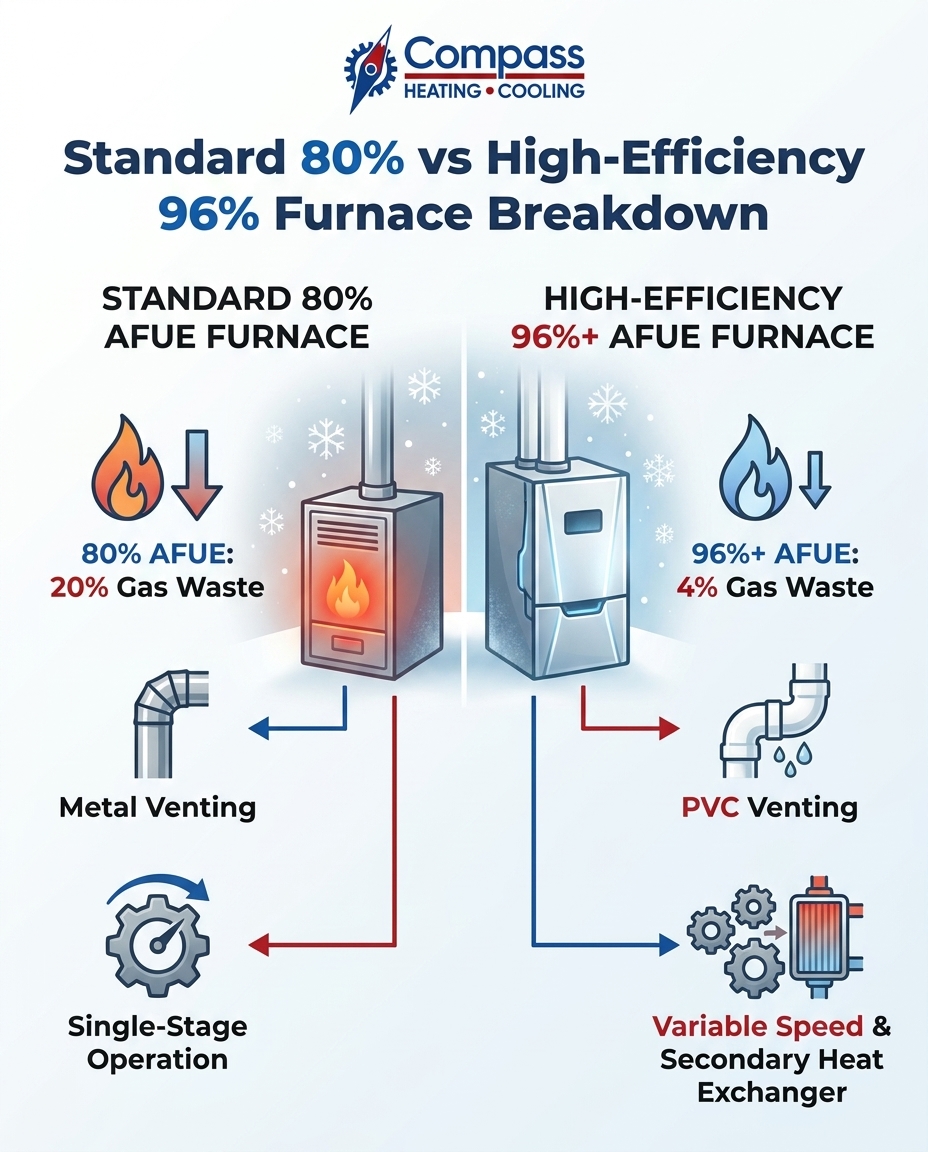
The 80% vs 96% AFUE gas utilization reality is straightforward but highly impactful over a long heating season. A standard 80% AFUE furnace wastes 20% of the gas it consumes. For every unit of energy you purchase from the utility company, one-fifth of it simply vents up the metal flue pipe and out into the atmosphere. In contrast, a 96% high-efficiency unit wastes only 4% of the fuel it uses. That represents a massive 16% reduction in raw fuel waste, permanently lowering the volume of gas required to keep your home at a comfortable temperature.
The mechanics of condensing technology:
Standard furnaces use a single primary heat exchanger. Once the combustion gases pass through this component, they are vented outside while they are still incredibly hot. High-efficiency models utilize condensing technology. These systems feature a secondary heat exchanger designed to capture the residual heat that standard models throw away. By extracting this secondary heat, the exhaust gases cool down so much that they condense into a liquid. This advanced extraction process is exactly how these units achieve that 96% to 98% efficiency rating.
If your current heating system is running constantly but failing to maintain the temperature on your thermostat, or if your utility usage has spiked without a corresponding weather change, these are strong signs it is time for a new furnace. Understanding these mechanical differences helps you see exactly where your energy is going.
Side-by-Side Comparison: Standard vs. Condensing Furnaces
Choosing the right system requires comparing the physical and operational differences between the two tiers. In our experience, while both will heat your home, the way they operate, vent, and perform in severe weather varies significantly.
• Technology — Standard 80% AFUE Furnace: Non-condensing, single primary heat exchanger. — High-Efficiency 96%+ Condensing Furnace: Condensing, primary and secondary heat exchangers.
• Venting Requirements — Standard 80% AFUE Furnace: Traditional metal flues (vents hot exhaust gases up a chimney or roof stack). — High-Efficiency 96%+ Condensing Furnace: PVC piping (vents cooler, acidic exhaust gases directly out a sidewall or roof).
• Gas Waste Reduction — Standard 80% AFUE Furnace: 20% of consumed gas is wasted as exhaust. — High-Efficiency 96%+ Condensing Furnace: 4% or less of consumed gas is wasted as exhaust.
• Operation Type — Standard 80% AFUE Furnace: Typically single-stage (runs at 100% capacity only). — High-Efficiency 96%+ Condensing Furnace: Often multi-stage or modulating (adjusts output to match the exact heating demand).
• Climate Suitability — Standard 80% AFUE Furnace: Adequate for milder, shorter winters. — High-Efficiency 96%+ Condensing Furnace: Highly recommended for long, severe freezing seasons.
Running the Math on Loveland Winter Payback Cycles
Calculating the return on investment for a high-efficiency system requires looking beyond the initial installation quote. The payback cycle is determined entirely by how often the furnace runs. In regions with short, mild winters, an 80% furnace might make sense because the system sits idle for most of the year. However, in our years of servicing HVAC systems in Loveland, we have seen firsthand how our local winters change the math completely.
With consistently freezing overnight temperatures stretching from October through April, local heating systems endure significantly longer operational cycles than the national average. When a furnace runs for six to seven months out of the year, a 16% reduction in gas consumption compounds rapidly. National calculators often assume milder winters, which artificially extends the estimated payback period. In Northern Colorado, the severe climate demand pushes high-efficiency systems into profitability much faster.
Upgrading to a 96% AFUE unit also acts as a long-term hedge against utility rate fluctuations. Because you are permanently lowering your total gas consumption by capturing heat that used to be wasted, your home becomes less vulnerable to future energy market spikes. If you are scheduling a heating installation and replacement with us, factoring in the length of the local heating season is the most accurate way to project your return on investment.
Why Operational Hours Matter Most
The correlation between outdoor temperature drops and furnace run times dictates your efficiency gains. During peak freezing months, a standard furnace must run almost continuously to combat the heat loss through your walls and windows, burning a massive volume of gas and wasting 20% of it every single hour.
Because a 96% unit operates with only a 4% waste margin, it maximizes your energy use precisely when you need it most. The more hours the system runs to fight off the Loveland cold, the faster the percentage-based savings accumulate, shrinking the payback cycle of the higher-tier equipment.
The Hidden ROI: Variable Speed and Consistent Comfort
When homeowners calculate ROI, they usually focus entirely on utility consumption. However, the return on your investment extends far beyond gas savings. Our customers consistently tell us that upgrading to a high-efficiency condensing furnace fundamentally changes how their home feels, providing a level of consistent physical comfort that standard models simply cannot match.
The end of the cold draft cycle:
Most older, 80% AFUE furnaces we replace are single-stage systems. This means they only have one setting: 100% capacity. When the thermostat calls for heat, the furnace blasts hot air into the rooms, quickly satisfies the thermostat, and shuts off. This creates a noticeable "blast of hot air followed by a cold draft" cycle as the house cools down again. The wide temperature swings make rooms feel drafty and uncomfortable.
Modulating heat and variable speed:
High-efficiency 96%+ systems typically feature multi-stage or fully modulating gas valves paired with variable-speed blower motors. Instead of blasting on and off, these furnaces can run at lower capacities (often as low as 40%) for longer, continuous periods. This smooths out the temperature swings, keeping the home perfectly consistent.
Furthermore, because the variable-speed blower runs continuously at a low, quiet speed, it constantly pulls air through your HVAC filter. This significantly improves indoor air quality by filtering out dust and allergens more effectively than a system that sits idle half the day. Better air quality, quieter operation, and perfectly even temperatures represent a tangible return on investment that you experience every single day.
Installation Realities: Venting Upgrades and Timing
As licensed HVAC professionals, we always prepare our clients for the reality that upgrading from an 80% AFUE standard furnace to a 96% AFUE high-efficiency model is not a simple "drop-in" replacement. The advanced condensing technology requires specific physical retrofits to your home's infrastructure, which is why planning your installation timing with our team is so important.
The Problem: Acidic Condensation
Standard furnaces vent exhaust gases at very high temperatures, which allows the exhaust to rise naturally up a traditional metal flue or masonry chimney. High-efficiency furnaces extract so much heat from the exhaust that the remaining gases cool and condense into a liquid. This liquid is slightly acidic.
The Cause: Secondary Heat Extraction
Because the secondary heat exchanger pulls the thermal energy out of the exhaust, the standard metal chimney is no longer safe or viable. If you were to vent a 96% furnace into a metal chimney, the acidic condensation would quickly corrode the metal, leading to severe structural damage and potential safety hazards.
The Solution: PVC Venting Retrofits
To safely expel this exhaust, a high-efficiency furnace requires dedicated PVC piping. The PVC pipes are completely resistant to the acidic condensation and are usually routed directly out the side of the house or up through the roof. Additionally, the system requires a condensate drain line to safely carry the liquid away from the unit.
Because running new PVC venting and drain lines takes additional labor and planning, a September pre-winter replacement is the ideal scenario. Handling these retrofits during the early fall ensures our installation crews have the time to properly route the venting, calibrate the variable-speed blower, and test the modulating gas valve before you actually need the heat. Waiting until a mid-winter breakdown forces an emergency installation makes these necessary retrofits much more stressful.
Maximizing Value with Generic Energy Rebates
One of the most effective ways we help homeowners offset the initial investment of a high-efficiency heating system is by pointing them toward available energy incentives. Because 96%+ AFUE condensing furnaces significantly reduce fossil fuel consumption, they are often incentivized by government programs and utility companies.
Upgrading to a qualifying high-efficiency system frequently makes homeowners eligible for federal energy tax credits. These credits are designed to reward property owners who invest in greener, more efficient technology. In addition to federal programs, local utility providers frequently offer rebates for replacing outdated, inefficient equipment with high-tier models.
These incentives effectively lower the upfront cost barrier, making the long-term ROI of a high-efficiency unit even more attractive. Because programs frequently update their qualification requirements and funding pools, we strongly advise consulting with a tax professional or your local utility provider for current, specific details regarding your home.
You can also check our current HVAC promotions and rebates to see how seasonal offerings can further offset your installation costs, making the transition to a 96% AFUE system a smart financial move before the winter hits.
Frequently Asked Questions About Furnace Upgrades
Is a 96% efficient furnace worth it in Colorado?
In our professional experience, yes. A 96% efficient furnace is highly beneficial in Colorado due to the length and severity of the winters. Because our heating season often stretches from October through April, the furnace runs for thousands of hours. The 16% reduction in gas waste compounds rapidly over these long operational periods, accelerating the payback cycle compared to milder climates.
What is the difference between 80% and 96% AFUE?
The primary difference is how much gas is wasted during the heating process. An 80% AFUE furnace exhausts 20% of the gas it consumes as waste up the chimney. A 96% AFUE furnace utilizes a secondary heat exchanger to capture that escaping heat, reducing the fuel waste to just 4% and significantly lowering your total gas consumption.
How do you calculate the ROI of a high-efficiency furnace?
You calculate the ROI by looking at the percentage of gas saved (typically 16% or more) and factoring in your local climate's operational hours. Instead of relying on generic national averages, our team considers how many months your system actually runs. The longer the winter, the more gas you save, and the faster the higher initial investment pays for itself through reduced utility usage.
Do high-efficiency furnaces run more often?
High-efficiency furnaces with variable-speed or modulating technology are designed to run more continuously, but at a much lower capacity. Instead of blasting on at 100% and shutting off completely, they may run at 40% capacity for longer periods. This uses less total energy while eliminating cold drafts and maintaining a perfectly even temperature in the home.
Can I vent a 96% furnace through my existing chimney?
No, you cannot vent a 96% condensing furnace through a standard metal or masonry chimney. The exhaust from a high-efficiency unit is so cool that it forms an acidic condensation. This liquid will quickly corrode traditional metal flues. Instead, our technicians must retrofit the system with dedicated PVC piping that safely vents the exhaust directly outside.
Secure Your Winter Comfort Before the Freeze
The decision between an 80% and a 96% AFUE furnace ultimately comes down to balancing immediate installation logistics with long-term fuel reduction and home comfort. While a standard unit may seem simpler upfront, the 80% vs 96% AFUE gas utilization reality proves that a high-efficiency system offers substantial, compounding benefits during a long Loveland winter.
Making this decision early in the fall allows our team to handle necessary PVC venting retrofits without the stress of an emergency mid-winter breakdown. By choosing a system with variable-speed technology and a secondary heat exchanger, you secure quieter operation, better air quality, and lower total fuel waste for years to come.
Do not wait until the first major freeze to evaluate your heating needs. Reach out to our Loveland heating experts at Compass Heating & Cooling today to assess your home's specific ductwork, venting requirements, and heating load, and book your installation consultation before the deep cold arrives.
hear what our satisfied clients have to say
Our clients consistently praise our exceptional service and attention to detail. They appreciate the personalized approach we take to meet their unique needs, ensuring satisfaction every step of the way.
.png)